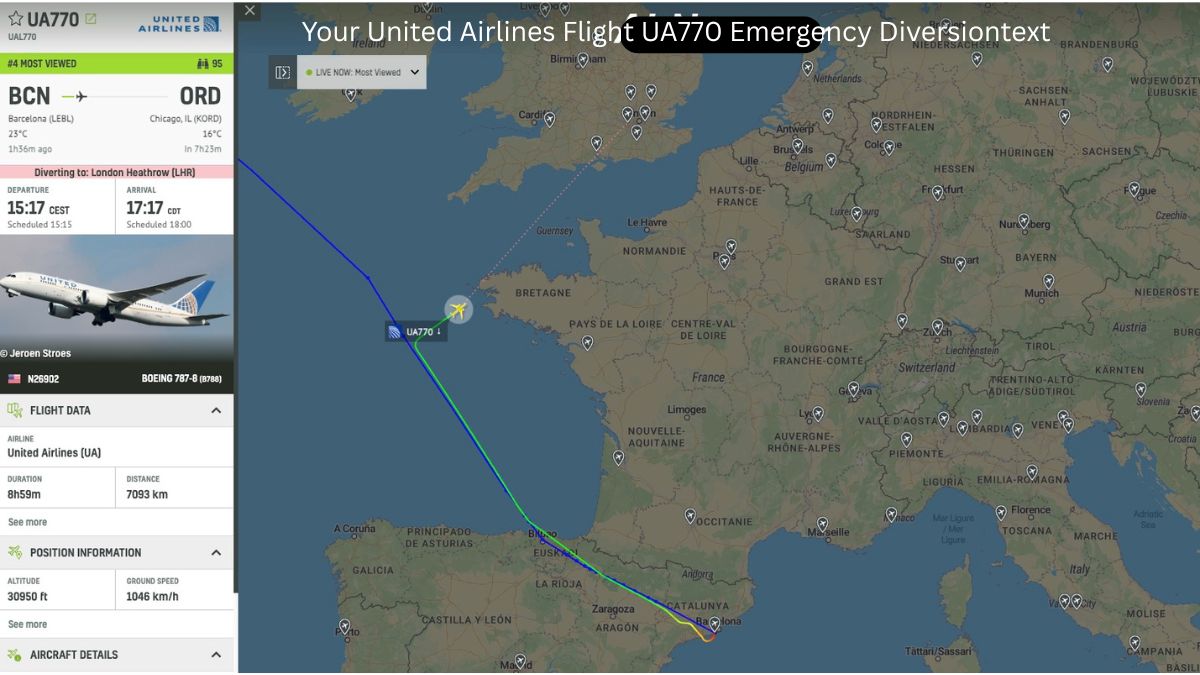
On May 27, 2025, United Airlines Flight UA770 departed from Barcelona–El Prat Airport (BCN) bound for Chicago O’Hare (ORD). Operated by a Boeing 787‑9 Dreamliner, the flight carried just over 200 passengers—eager travelers settling in for a transatlantic adventure. Initially, the flight was uneventful, cruising at 35,000 ft, showcasing the Dreamliner’s sleek lines and whisper‑quiet engines. But around two hours into the flight, routine turned into urgency.
🕒 2. Timeline of the Incident
| Time (local) | Event Description |
|---|---|
| ~14:30 CEST | Takeoff from Barcelona, cruising at 35,000 ft. |
| ~16:30 CEST | Technical anomaly detected; crew communicates with ATC. |
| Shortly after | Transponder squawks 7700 (general emergency code). |
| ~16:55 BST | Diverts and safely lands at Heathrow’s Runway 27R. |
| Immediately post-landing | Emergency services stand by; passengers disembark safely. |
🚨 The Emergency Declaration: Squawk 7700
-
Technical irregularity detected
While specific details weren’t disclosed, the crew became aware of a significant technical anomaly. Acting swiftly, they recognized that continuing to ORD was not safe. -
Mayday via transponder
To declare the situation serious, pilots elected to “squawk 7700”, an international “general emergency” code that automatically alerts all air traffic control systems along the flight path.
That simple action triggers an immediate, automatic priority response—clearing airways and summoning ground services for a prompt and safe landing.
🌍 Why Heathrow? Choosing the Best Airport
-
Strategic proximity
As the flight neared UK airspace, London Heathrow emerged as the fastest, most capable diversion option in terms of runway length, traffic handling, and emergency support availability. -
Robust infrastructure
Heathrow’s advanced fire, medical, and security teams—paired with its capacity to accommodate a large wide‑body like the 787—made it the best landing site.
By approximately 4:55 PM BST, the Dreamliner touched down smoothly on Runway 27R, and emergency vehicles immediately surrounded it.
👩✈️ Crew & ATC: A Study in Coordination
-
Pilots’ quick diagnosis
They identified the problem, decided it was serious, and acted without delay—safety over schedule. -
Clear communication
Cabin crew were informed first, then passengers were briefed: “There’s a technical issue, we’re diverting, nothing to worry about—we’ll keep you in the loop.” -
ATC clarity
Once the squawk code went up, all civil aviation authorities along the route were looped in, freeing a path to Heathrow and alerting ground emergency responders.
This kind of multi-layered coordination—from pilots to ATC to ground crews—showcases aviation’s safety-first blueprint.
😌 Onboard Experience: Calm Amid Crisis
-
Reassurance over alarm
While any emergency announcement sparks concern, crew chose a balanced tone—informing without inciting panic. -
Orderly guidance
Passengers followed instructions, stayed seated, and remained alert but at ease. -
Ground readiness
Upon landing, fire trucks, ambulances, and security were on standby. Everyone disembarked safely, smoothly, and without incident.
🔍 Investigations & Aftermath
-
Aircraft inspection
Engineers immediately began checks to identify what caused the diversion—whether a sensor failure, electrical fault, or system alert. -
Customer care
United Airlines initiated rebooking procedures, provided accommodations, and began support services for customers affected by the diversion. -
No injuries, no headlines
With safety prioritized and no one hurt, the incident remained under the radar—yet it offered lessons in professionalism and preparedness.
📚 Broader Takeaways
-
Additional fuel saved the day
Aircraft carry alternate fuel precisely for this type of contingency—enough to fly to nearest airport if needed. -
Squawk 7700 saves lives
That universal emergency ID code instantly reshapes airspace and ground readiness. -
Crew calmness matters
Clear, calm announcements keep passengers cooperative and composed during disruptions. -
System-wide safety nets
From pilot training to ATC protocols to emergency response teams—the aviation network ensures multiple layers of safety.
🎯 Key Lessons for Travelers
-
Stay alert
When crew deliver unexpected updates, listen closely—they guide you through the process. -
Trust the process
Diversions are not failures—they’re safety safeguards. -
Prepare to flex
Carry essentials in your carry-on—diversions might mean unexpected overnight stays. -
Ask for support
Airlines often provide meals, hotels, or alternate travel, especially on long diversions.
🚦 Final Word: A Success in Crisis
United Flight UA770’s unscheduled landing at Heathrow on May 27, 2025, is a textbook case of aviation safety at its best. The crew adhered to protocols, the aircraft followed engineered safeguards, ATC activated priority routing, and ground teams executed a calm, efficient landing. With zero injuries, and no dramatic headlines, the event ended as it began—an ordinary flight—though with a valuable story of professionalism and systems working flawlessly.
Think of UA770 not as a failure of flight, but as a success of structure—when the unimaginable happens, the very real machinery of safety takes over.