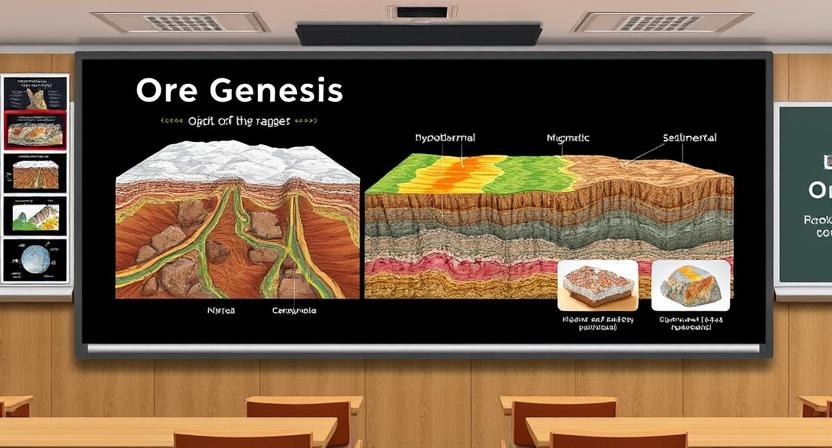
The study of ore genesis is a fundamental aspect of geology, mining engineering, and earth sciences. It helps us understand how valuable mineral deposits are formed, distributed, and concentrated in the Earth’s crust. For students and professionals, an ore genesis lecture PPT (PowerPoint presentation) serves as a vital educational resource, offering structured visuals, diagrams, and explanations that simplify a complex subject.
This article provides an in-depth exploration of ore genesis, discusses its importance in geology and mining, and explains how a lecture PPT can be structured for better learning. The aim is to equip readers with a comprehensive understanding of ore formation processes and how lecture presentations can enhance knowledge delivery.
What is Ore Genesis?
Ore genesis refers to the geological processes responsible for the formation and concentration of mineral deposits into economically viable ore bodies. While minerals occur naturally throughout the Earth, only certain geological conditions allow them to accumulate in amounts significant enough to be mined profitably.
Key Points of Ore Genesis:
-
Mineral Formation – Minerals crystallize and form under specific pressure, temperature, and chemical conditions.
-
Transport Mechanisms – Fluids, gases, or molten magma transport mineral constituents through the Earth’s crust.
-
Concentration Processes – Geological processes gather and concentrate minerals into ore deposits.
-
Economic Importance – Without ore genesis, modern industries dependent on metals such as gold, copper, and iron would not exist.
Types of Ore Deposits
An ore genesis lecture PPT typically outlines the different types of ore deposits, categorized by their formation process.
1. Magmatic Deposits
-
Formed directly from cooling magma.
-
Common examples: Nickel, chromium, and platinum group elements.
-
Occur in layered igneous intrusions.
2. Hydrothermal Deposits
-
Minerals precipitate from hot, mineral-rich fluids circulating through fractures in rocks.
-
Examples: Gold, silver, copper, lead, and zinc.
-
Found in veins and disseminated deposits.
3. Sedimentary Deposits
-
Formed by precipitation of minerals in sedimentary basins.
-
Examples: Banded iron formations, manganese nodules.
-
Result from chemical and biological processes.
4. Metamorphic Deposits
-
Created by recrystallization of minerals under high heat and pressure.
-
Examples: Graphite, talc, and some gold deposits.
5. Placer Deposits
-
Formed by weathering and erosion of rocks containing heavy minerals.
-
Deposited in riverbeds and shorelines.
-
Common examples: Gold, tin, and diamonds.
Stages of Ore Genesis
In a well-structured ore genesis lecture PPT, the stages of ore formation are usually explained in sequential order:
-
Source Stage – Identification of the source of metals and minerals, such as the mantle or crust.
-
Transport Stage – The movement of mineral-rich solutions, magmas, or sediments.
-
Deposition Stage – Minerals are deposited when environmental conditions (temperature, pressure, chemistry) change.
-
Post-formation Stage – Includes supergene enrichment, weathering, or metamorphism altering the original ore body.
Importance of Ore Genesis in Geology and Mining
Academic Perspective
-
Helps students and researchers understand mineral distribution.
-
Provides frameworks for geological mapping and exploration.
-
Essential for developing teaching materials like lecture PPTs.
Industrial Perspective
-
Guides exploration companies in identifying potential mining sites.
-
Supports sustainable extraction of resources.
-
Helps evaluate the economic feasibility of mining projects.
Environmental Perspective
-
Understanding ore genesis aids in predicting environmental impacts.
-
Assists in planning mine rehabilitation and reclamation.
-
Encourages responsible resource management.
Structuring an Effective Ore Genesis Lecture PPT
A lecture PPT must not only present facts but also engage learners visually. Here’s a suggested structure for an ore genesis presentation:
-
Title Slide – “Ore Genesis Lecture PPT” with course and instructor details.
-
Introduction – Definition and importance of ore genesis.
-
Classification of Ore Deposits – Visual diagrams and flowcharts.
-
Geological Processes – Magmatic, hydrothermal, sedimentary, and metamorphic examples.
-
Case Studies – Famous deposits like Witwatersrand (South Africa), Sudbury Basin (Canada), and Carlin Gold (USA).
-
Diagrams & Models – Illustrations showing how minerals migrate and concentrate.
-
Economic Significance – Application in mining and industry.
-
Summary & Conclusion – Key takeaways.
-
FAQs or Discussion Slide – For interactive classroom engagement.
By integrating diagrams, flowcharts, and animations, students can grasp complex processes more effectively.
Challenges in Studying Ore Genesis
-
Complex Processes – Multiple geological mechanisms operate simultaneously.
-
Data Limitations – Subsurface studies are often limited to drill cores.
-
Environmental Concerns – Linking ore genesis with sustainable mining is still evolving.
-
Technological Dependence – Requires advanced tools like GIS, geochemical analysis, and remote sensing.
Future Perspectives
The study of ore genesis is continuously evolving with advancements in technology. Modern tools such as isotopic dating, 3D geological modeling, and geophysical surveys allow scientists to study ore deposits with greater accuracy. An ore genesis lecture PPT in the future may include AI-driven simulations, interactive 3D animations, and real-time geological mapping data.
Furthermore, as global demand for metals increases—especially for renewable energy technologies (like lithium, cobalt, and rare earth elements)—understanding ore genesis will remain crucial for sustainable resource exploration.
Conclusion
Ore genesis is a cornerstone of geology and mining sciences. By studying how ore deposits form, scientists, engineers, and students gain insights into resource availability, economic potential, and environmental considerations. A well-structured ore genesis lecture PPT not only organizes these concepts but also makes learning interactive, visual, and impactful.
Whether for students preparing for exams, researchers exploring new deposits, or industry professionals evaluating resource potential, ore genesis remains a subject of enduring importance.
FAQs about Ore Genesis Lecture PPT
Q1. What is the purpose of an ore genesis lecture PPT?
A. It provides a structured, visual explanation of mineral formation processes to enhance learning for students and professionals.
Q2. What are the main types of ore deposits covered in such a presentation?
A. Magmatic, hydrothermal, sedimentary, metamorphic, and placer deposits.
Q3. How do hydrothermal fluids contribute to ore genesis?
A. Hydrothermal fluids transport dissolved metals and deposit them when conditions change, forming veins or disseminated ores.
Q4. Why is ore genesis important for mining?
A. It helps exploration geologists identify profitable mineral deposits and guides sustainable extraction practices.
Q5. How can a PPT make ore genesis easier to understand?
A. By using diagrams, flowcharts, animations, and case studies, complex geological processes become visually engaging and easier to comprehend.