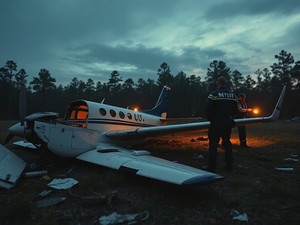
The news headline “Aircraft Crash Georgia” evokes a immediate and somber response. While each event is a unique tragedy, they collectively form a critical area of study for aviation safety experts, investigators, and the communities living beneath flight paths. The state of Georgia, with its major international hub in Atlanta, significant military presence, and diverse general aviation activity, has experienced its share of aviation accidents. Understanding the nature of these incidents, the response they trigger, and the lessons learned is essential for contextualizing these events beyond the initial shock of the headline.
Georgia’s airspace is some of the busiest in the world. Hartsfield-Jackson Atlanta International Airport (ATL) has consistently ranked as the world’s busiest passenger airport, with a constant stream of commercial airliners arriving and departing. Beyond this, the state is home to numerous regional airports, military bases like Robins AFB and Moody AFB, and a vibrant community of private pilots. This high volume and variety of aerial activity, while statistically very safe, means that the potential for incidents exists across a wide spectrum of aviation.
The Anatomy of an Aircraft Crash Response in Georgia
When an aircraft goes down in Georgia, a highly coordinated and specialized response is immediately set into motion. The nature of the response depends heavily on the type of aircraft and the location of the crash.
-
Alert and Notification: The process typically begins with a lost communication or radar signal, or more urgently, a distress call from the pilots. Air traffic control centers, notably the Atlanta Air Route Traffic Control Center in Hampton, which handles a vast swath of southeastern U.S. airspace, are the first points of awareness. They immediately alert search and rescue authorities.
-
Multi-Agency Mobilization: A crash triggers a massive inter-agency response. This includes:
-
Local First Responders: County sheriffs’ offices, local police, and fire departments are usually the first on the scene to secure the area, provide emergency medical aid, and fight any post-crash fires.
-
State Agencies: The Georgia State Patrol assists with large-scale perimeter security and traffic control. The Georgia Emergency Management and Homeland Security Agency (GEMA/HS) coordinates state resources and support for local jurisdictions.
-
Federal Investigators: The National Transportation Safety Board (NTSB) is the primary federal agency responsible for investigating civil aviation accidents. A “Go-Team” of experts in structures, powerplants, systems, air traffic control, and human performance is dispatched to the site. Their goal is not to assign blame but to determine the probable cause and issue safety recommendations to prevent future accidents.
-
The FAA: The Federal Aviation Administration participates in the investigation, particularly concerning air traffic control procedures, aircraft certification, and pilot licensing.
-
Military Investigators: If the crash involves a military aircraft, the U.S. Air Force, Navy, or Army will lead their own investigation through a specially convened Aircraft Accident Investigation Board (AAIB), often with NTSB participation.
-
-
The Investigation Process: The scene is treated as a forensic laboratory. Investigators map the debris field, which can tell a story about the aircraft’s angle, speed, and condition at impact. Key components like the engines and flight control systems are examined. Perhaps the most crucial pieces of evidence are the flight data recorder (FDR or “black box”) and the cockpit voice recorder (CVR), which provide objective data and audio from the cockpit in the moments leading up to the crash.
Common Factors in Georgia Aviation Accidents
While every accident is unique, investigations often point to recurring themes, many of which are not specific to Georgia but are reflected in national data:
-
General Aviation (GA) Incidents: The vast majority of aircraft accidents in the U.S., and by extension in Georgia, involve private, small general aviation aircraft. These can stem from pilot error (like loss of control), mechanical failure, fuel exhaustion, and inadvertent flight into adverse weather conditions (IMC).
-
Weather: Georgia’s weather can be highly variable and change rapidly. Summer thunderstorms with severe turbulence, wind shear, and lightning pose significant risks. Winter ice can be a factor at higher altitudes. Pilots, especially those in smaller aircraft without sophisticated radar, must be highly vigilant.
-
Mid-Air Collisions: While extremely rare due to modern traffic alerting systems, the congested airspace around Atlanta presents a risk that air traffic controllers and pilots work tirelessly to mitigate.
-
Controlled Flight Into Terrain (CFIT): This occurs when an airworthy aircraft is unintentionally flown into the ground, water, or an obstacle. This is often a risk during approach and landing, particularly in conditions of low visibility. While advanced cockpit systems have reduced CFIT accidents globally, it remains a focus area.
-
Military Training Flights: Georgia’s military bases host extensive training operations. These flights can involve high-speed, low-altitude maneuvers that carry inherent risks. Crashes like the 2018 incident involving a C-130 Hercules in Savannah, while tragic, are investigated with immense rigor to ensure training protocols remain as safe as possible.
The Human Impact and Community Response
Beyond the technical investigation, an aircraft crash is a profound human tragedy. It affects the families and friends of those on board, the first responders who witness the scene, and often the entire community. In close-knit rural communities where a crash might occur, the event can be deeply traumatic. Memorials are often erected at crash sites to honor the lives lost, serving as a permanent reminder of the event.
The ultimate goal of every investigation is to enhance safety. Recommendations from the NTSB following a crash in Georgia can lead to changes in FAA regulations, modifications to aircraft design, updated pilot training requirements, and improvements in air traffic control procedures. In this way, the painful lessons learned from each accident contribute to the remarkable safety record of commercial aviation and help make general aviation safer for everyone.
Informational FAQ: Aircraft Crashes in Georgia
Q1: Who is in charge of investigating a private plane crash in Georgia?
A: The National Transportation Safety Board (NTSB) is the primary agency for investigating all civil aviation accidents in the United States, including those in Georgia. Local law enforcement secures the site, but the NTSB leads the technical investigation.
Q2: What should I do if I witness an aircraft crash?
A: Your immediate priorities are safety and reporting. First, do not approach the crash site. There may be fire, hazardous materials, or unstable wreckage. Call 911 immediately. Provide the dispatcher with your location (use landmarks if in a remote area) and any details you observed. Wait for emergency responders to arrive and follow their instructions.
Q3: How common are commercial airline crashes in Georgia?
A: Major commercial airline crashes are extremely rare events. The U.S. commercial aviation system has an outstanding safety record due to rigorous regulations, advanced technology, and continuous improvement based on past accident investigations. While Georgia has a very high volume of air traffic, the last major commercial airline crash in the state was in 1995 (Atlantic Southeast Airlines Flight 529).
Q4: Are military aircraft crashes investigated by the same people?
A: While there is cooperation, military aircraft crashes are investigated by a separate Aircraft Accident Investigation Board (AAIB) from the specific branch of service involved (e.g., U.S. Air Force). The NTSB often sends representatives to participate in these investigations as well.
Q5: Why does it sometimes take over a year to get a final report on a crash?
A: Aviation accident investigation is a meticulous, science-driven process. Investigators must collect all evidence, analyze wreckage, review radar and ATC data, perform lab tests on components, and meticulously study the contents of the flight recorders. This data is then synthesized into a comprehensive report that undergoes a lengthy review process to ensure absolute accuracy before a final “probable cause” is determined.
Q6: Has an aircraft ever crashed into Hartsfield-Jackson Atlanta International Airport?
A: Thankfully, no major crash has occurred on the airport property itself in the modern jet era. The airport has an excellent safety record, though it has been the origin or destination of aircraft that have crashed elsewhere.