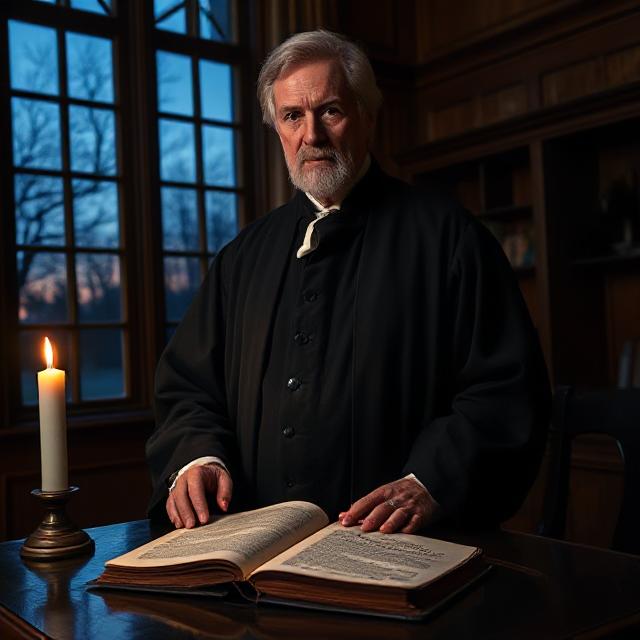
In the pantheon of American Founding Fathers, names like Washington, Jefferson, and Adams resonate with immediate recognition. Their portraits are iconic, their words etched into the nation’s foundation. Yet, the American Revolution was not solely a political or military struggle; it was also a profound intellectual and moral battle of ideas. Guiding this philosophical charge was a formidable, sharp-witted Scottish Presbyterian minister and educator: Dr. John Witherspoon. More than any other figure, he served as the vital bridge between the fervent piety of the Great Awakening and the enlightened principles of republican government, earning his indispensable role as the only active clergyman to sign the Declaration of Independence.
Witherspoon’s story begins not in the New World, but in the rugged intellectual landscape of Scotland. Born in 1723 in Gifford, East Lothian, he was ordained a minister in the Church of Scotland (Presbyterian) and quickly gained a reputation as a powerful preacher, a staunch defender of orthodox Calvinism against the encroaching philosophies of the Enlightenment, and a leader of the “Popular Party” that opposed patronage in church appointments. His intellect was formidable, his demeanor often described as stern and uncompromising. He was, by all accounts, a significant figure in Scottish ecclesiastical politics—a man seemingly on a path confined to the borders of his homeland.
However, in 1768, a transatlantic invitation altered the course of his life and, consequently, American history. The College of New Jersey (which would later be renamed Princeton University) was floundering. Its presidents, including the brilliant Jonathan Edwards, had died shortly after taking office. The trustees sought a leader of intellectual rigor and moral fortitude to revive the institution. They looked across the ocean to the renowned Dr. Witherspoon.
After much persuasion—his wife, Elizabeth Montgomery, was initially terrified of the sea voyage and the wilderness of America—Witherspoon accepted. He arrived in New Jersey in 1768 with his family and an immense library, a symbol of his commitment to learning. His impact on the college was immediate and transformative. He reformed the curriculum, injecting it with the Scottish Enlightenment’s emphasis on moral philosophy, common sense realism, and practical education. He believed that learning should produce virtuous citizens and capable leaders, not just scholarly theologians.
Witherspoon’s philosophy, often called “Scottish Common Sense Realism,” was revolutionary in its accessibility. It argued that all people, through their innate common sense and observation, could perceive basic truths about the world, morality, and governance. This was a direct rebuttal to more complex British empirical theories and provided a powerful intellectual framework for the American cause. If all people could discern truth and morality, then they were capable of self-government. This idea became the bedrock of revolutionary thought, and Witherspoon imbued it in an entire generation of students.
His lecture hall became the incubator for the American republic. Among his pupils were James Madison, the “Father of the Constitution”; Aaron Burr, future Vice President; Philip Freneau, the “Poet of the American Revolution”; a future U.S. Supreme Court justice; and dozens of senators, congressmen, and state governors. He taught them not what to think, but how to think—to apply reason, ethics, and a deep sense of civic duty to the problems of governance. James Madison, in particular, absorbed Witherspoon’s lessons on the nature of man, the separation of powers, and the need to check ambition with ambition, concepts that would find their ultimate expression in the U.S. Constitution.
As tensions between the colonies and Great Britain escalated, Witherspoon’s sermons and writings began to echo with political urgency. He deftly wove together theological justification with Enlightenment philosophy to argue for resistance. He famously countered the Loyalist claim that the colonies were too Christian to rebel with the retort, “It is in the interest of the people to have the right of government. For if it is not there, it is a usurpation.” For Witherspoon, liberty was not just a political desire; it was a divine right and a moral imperative.
His influence moved swiftly from the pulpit and classroom to the political arena. He was elected to the New Jersey Provincial Congress and, in June 1776, was chosen as a delegate to the Continental Congress in Philadelphia. He arrived just in time for the most momentous vote in American history. When the issue of independence was debated, a colleague argued the nation was not yet “ripe” for such a declaration. Witherspoon, drawing on his ministerial authority, is reported to have declared, “It is not only ripe for the measure, but in danger of rotting for the want of it.” His argument carried the weight of both a man of God and a man of reason.
On August 2, 1776, Dr. John Witherspoon inked his name to the Declaration of Independence, boldly committing his life, his fortune, and his sacred honor to the cause. He served in Congress for nearly six years, working tirelessly on over one hundred committees, helping to shape the Articles of Confederation, and mobilizing the Presbyterian church network to support the war effort. The conflict touched him personally; his son, James, was killed at the Battle of Germantown in 1777.
The post-war years were marked by personal tragedy and continued public service. He worked to rebuild the ravaged College of New Jersey, which had been severely damaged during the war. He continued to preach and teach until his death in 1794, blind but intellectually sharp to the end.
Dr. John Witherspoon’s legacy is multifaceted. He is the father of American Presbyterianism and a foundational figure in American higher education. But his most profound contribution was as the moral and intellectual architect of the revolution. He provided the philosophical tools and educated the leadership that crafted a nation. He proved that faith and reason, piety and politics, could be fused together to create a movement powerful enough to forge a new republic. He was the minister who didn’t just pray for a nation; he put his pen to parchment and signed one into existence.
Informational FAQs
1. Was John Witherspoon a president of the United States?
No, John Witherspoon was never President of the United States. He was, however, the president of the College of New Jersey (now Princeton University) from 1768 until his death in 1794.
2. What was Witherspoon’s role in the Continental Congress beyond signing the Declaration?
He was an incredibly active member. He served on over 100 committees, including the critical Board of War and the Committee on Secret Correspondence (a precursor to the Department of State). He helped draft the Articles of Confederation and used his extensive network to secure loans and supplies for the Continental Army.
3. How did Witherspoon reconcile his role as a minister with political revolution?
Witherspoon saw no contradiction. He believed that defending liberty and opposing tyranny were moral and religious duties. He preached that God willed civil and religious liberty for all people and that resisting the oppression of the British Crown was not just permissible but righteous.
4. What is Scottish Common Sense Realism, and why was it important?
This philosophy, which Witherspoon championed, posits that ordinary people can perceive reality and understand fundamental truths (like right and wrong) through their innate common sense, without needing complex philosophical systems. This empowered the revolutionary idea that ordinary men were capable of self-government, making them not subjects of a king but citizens of a republic.
5. Are there any notable descendants of John Witherspoon?
Yes, among his most famous descendants is the late American actor, John Witherspoon, known for his roles in the “Friday” film series and “The Wayans Bros.” television show. The actor often spoke with pride about his relation to the Founding Father.