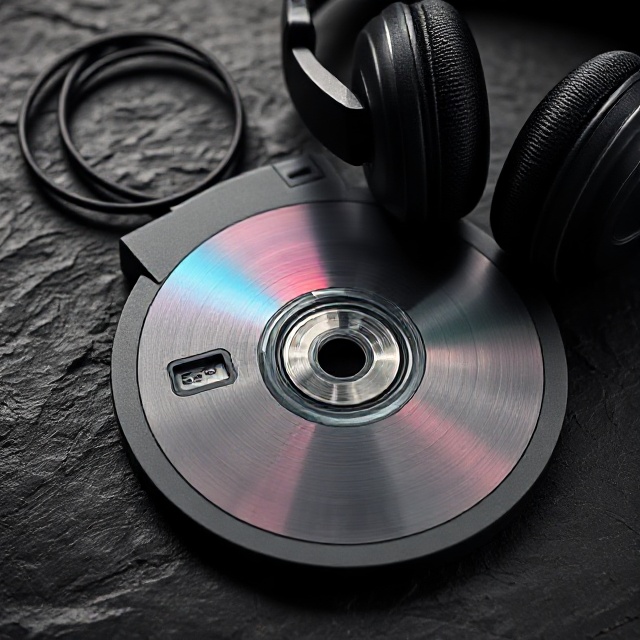
In the pantheon of audio codecs, a few names dominate the conversation. MP3 is the ubiquitous king of compression, AAC is its efficient successor, and FLAC is the current gold standard for lossless archiving. Yet, nestled in the annals of audio engineering history lies a format that was both revolutionary and, ultimately, a road not fully taken: ATRAC Lossless (ATRAC Advanced Lossless, or AAL).
To understand ATRAC Lossless, one must first journey back to its pervasive predecessor: ATRAC (Adaptive Transform Acoustic Coding). Developed by Sony in the early 1990s, original ATRAC was a lossy codec. Its raison d’être was the MiniDisc (MD), a revolutionary but physically tiny optical disc format. The challenge was immense: fit up to 80 minutes of CD-quality (or near-CD-quality) audio onto a disc smaller than a business card. ATRAC was the ingenious solution.
Using psychoacoustic principles, ATRAC worked like a sophisticated audio sculptor. It analyzed the audio signal and cleverly discarded sonic information that the human ear was least likely to perceive—masked frequencies, very quiet sounds played simultaneously with louder ones. This allowed for a massive reduction in file size while striving to preserve the perceptual quality of the original recording. For millions, ATRAC and the MiniDisc represented the peak of portable audio in the pre-MP3 player era.
However, the dawn of the new millennium brought a demand for true fidelity. As hard drive capacities grew and the concept of “digital archives” took hold, the audiophile community began to seek perfection: codecs that could reduce file size without discarding a single bit of data. This is the realm of lossless compression, exemplified by formats like FLAC (Free Lossless Audio Codec) and Apple Lossless (ALAC).
Sony, with its vast ecosystem of Hi-Fi components, Walkmans, and the newly emerging PlayStation Portable (PSP), needed an answer. They needed a format that was backward compatible with their massive investment in standard ATRAC, while also offering a true lossless option. Their solution, launched in the mid-2000s, was ATRAC Lossless.
The Technical Brilliance of ATRAC Lossless
ATRAC Lossless wasn’t just a new codec; it was a clever hybrid architecture. A single .oma or .aa3 (the file extensions for ATRAC Lossless) file contained two complete streams of audio data:
-
A Core Lossy Stream: This was a complete, standard lossy ATRAC3 or ATRAC3plus audio track. This ensured that any device that could play standard ATRAC files—from an old MiniDisc player to a Sony Network Walkman—could instantly play this core part of the file without any additional processing.
-
A Lossless Correction Stream: Bundled alongside the core stream was a second chunk of data. On its own, this data was useless noise. However, when decoded by a device that understood ATRAC Lossless, this “correction data” would be applied to the core lossy stream. Mathematically, it would perfectly reconstruct the original audio waveform, bit-for-bit identical to the source CD or master file.
This backward compatibility was its masterstroke. It allowed users to build a single library of music. When transferred to an older device, it would play the high-quality lossy core. When played on a newer, supported device like a Hi-MD Walkman or a Sony VAIO computer with SonicStage software, it would unlock the full lossless experience. This dual-nature future-proofed the library in a way that pure lossless formats like FLAC could not within the Sony ecosystem.
Why Didn’t ATRAC Lossless Conquer the World?
Despite its technical elegance, ATRAC Lossless never achieved widespread adoption. Several factors conspired against it:
-
The Walled Garden of SonicStage: Sony’s proprietary software, SonicStage, was the only way to manage, transfer, and encode ATRAC Lossless files. While it improved over time, it was often criticized for being cumbersome, buggy, and restrictive compared to the simple drag-and-drop functionality emerging elsewhere.
-
The Rise of FLAC and the Open-Source Movement: FLAC emerged as a robust, royalty-free, and open-source lossless format. It was supported by a wide range of software (foobar2000, Winamp, etc.) and hardware developers, creating a broad, interoperable ecosystem. ATRAC Lossless, by contrast, remained locked inside Sony’s hardware.
-
The DRM Dilemma: Sony’s music ecosystem of this era was heavily invested in Digital Rights Management (DRM). Files transferred to players were often locked, creating a frustrating user experience. The open nature of FLAC and even Apple’s relatively smooth ecosystem made Sony’s approach feel restrictive.
-
The MP3 Juggernaut: By the mid-2000s, the MP3 format had already won the portable music war. The iPod and iTunes combination simplified music acquisition and management for the masses, who were largely satisfied with “good enough” audio quality from AAC or MP3 files. The market for lossless audio was, and still is, a niche.
-
Sony’s Strategic Shift: Eventually, even Sony could not ignore market forces. The company began to phase out ATRAC support in its devices around 2010-2011. The last versions of SonicStage were released, and Sony moved towards supporting MP3 and later, FLAC, in its high-resolution audio players, finally embracing the standards the market had chosen.
The Legacy of ATRAC Lossless
Today, ATRAC Lossless is a fascinating footnote in audio history. It serves as a testament to a period of intense innovation and corporate-specific format wars. For archivists and audio historians, ATRAC Lossless files remain as perfect snapshots of that era, though they can be challenging to play on modern systems without legacy hardware or software emulation.
Its story is a cautionary tale about the importance of open standards and user experience over purely technical superiority. While ATRAC Lossless was a brilliant engineering solution to the problem of backward compatibility and lossless compression, it was ultimately overshadowed by formats that prioritized freedom and interoperability.
It represents a unique “what if” scenario. Had Sony open-sourced the codec or adopted a less restrictive software approach, the audio landscape might look different. Instead, ATRAC Lossless remains a beloved relic for MiniDisc enthusiasts and a symbol of Sony’s ambitious, if isolated, pursuit of audio perfection.
Informational FAQ
Q1: Is ATRAC Lossless the same as regular ATRAC?
A: No. Regular ATRAC (and its variants like ATRAC3) is a lossy codec, meaning it permanently discards some audio data to reduce file size. ATRAC Lossless is a lossless codec that provides perfect, bit-for-bit reproduction of the original audio, using a hybrid structure that contains a lossy core for backward compatibility.
Q2: Can I still play ATRAC Lossless files today?
A: It is challenging but possible. The primary method is to use the original SonicStage software on a Windows PC (or in a virtual machine). Some modern media players like VLC have varying levels of support for the .oma container format, but full reliability is not guaranteed. The most reliable way remains using the original Sony hardware it was designed for.
Q3: Was ATRAC Lossless better than FLAC?
A: “Better” is subjective. Technically, both are lossless, so their audio output is identical to the original source. The difference was in their design philosophy. ATRAC Lossless offered backward compatibility with older ATRAC devices, a unique feature. FLAC, being open-source and universally supported, offered greater flexibility and interoperability, which is why it became the standard.
Q4: What was the file extension for ATRAC Lossless files?
A: They commonly used the .oma or .aa3 file extensions. These containers could hold both standard lossy ATRAC and the lossless AAL streams.
Q5: Did ATRAC Lossless support high-resolution audio (e.g., 24-bit/96kHz)?
A: The standard ATRAC Lossless codec was primarily designed for CD-quality audio (16-bit/44.1kHz). While Sony had other high-resolution formats, ATRAC Lossless itself was not a major vehicle for hi-res audio, which was another factor in its niche status as FLAC and ALAC began supporting hi-res effortlessly.
Q6: Why would someone use ATRAC Lossless today?
A: Today, its use is almost entirely historical or archival. Someone might use it to perfectly archive music they originally encoded in the SonicStage ecosystem without re-ripping CDs. For any new lossless encoding, FLAC is the universal and recommended choice due to its widespread support and lack of licensing restrictions.