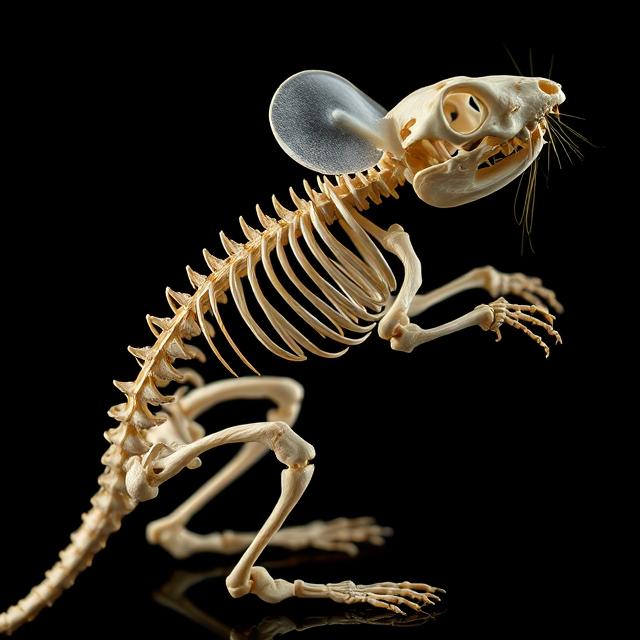
Do Mice Have Bones: The sight of a mouse effortlessly skittering through a gap no wider than a coin or flattening its body to vanish into a minuscule crack is enough to make anyone question the very laws of physics. This incredible ability has fueled a common and persistent myth: that mice are boneless, or at the very least, made entirely of cartilage, like an octopus or a slug. So, let’s address the central question head-on.
Yes, mice absolutely have bones.
In fact, mice, like all mammals, are vertebrates, meaning they possess a complex internal skeleton made of bone and cartilage. This skeleton provides critical structure, protects vital organs, and allows for movement. The misconception that they are boneless is a fascinating example of how observable animal behavior can lead to an entirely incorrect biological assumption. The truth is not that mice lack bones, but that their bones, in conjunction with a uniquely adaptable body plan, are engineered for supreme flexibility and survival.
The Marvel of the Murine Skeleton
A mouse’s skeleton shares the same fundamental blueprint as that of a human, a cat, or an elephant. It is divided into two main parts: the axial skeleton (the skull, vertebral column, and rib cage) and the appendicular skeleton (the bones of the limbs and girdles).
1. The Skull: The mouse skull is a complex structure made of many fused bones, designed to house and protect the brain and sensory organs. Its jaws are powerful for their size, equipped with the iconic incisors that grow continuously throughout their lives. The skull’s structure is a key identifier for species and is incredibly durable relative to the animal’s size.
2. The Vertebral Column (Spine): This is the central pillar of the skeleton. A mouse’s spine is remarkably flexible due to the number and shape of its vertebrae and the cushioning discs between them. This flexibility is the primary secret behind their contortionist acts. They can twist, bend, and compress their spinal column to a degree that would be impossible for larger, more rigid mammals.
3. The Rib Cage: The ribs form a protective cage around the heart and lungs. Unlike in humans, where the rib cage is fairly rigid, a mouse’s rib cage has a degree of flexibility that allows for compression. When a mouse squeezes through a tight space, it can momentarily compress its rib cage, reducing its thoracic volume to fit.
4. The Appendicular Skeleton: This includes the shoulder and pelvic girdles and the bones of the legs and feet. A mouse’s limbs are perfectly proportioned for climbing, digging, and rapid movement. Their feet have delicate bones that allow for precise grip and silent movement.
Debunking the Myth: Why Do We Think They’re Boneless?
The myth of the boneless mouse arises from a perfect storm of anatomical and behavioral adaptations.
-
Extreme Flexibility: As mentioned, the key is the highly flexible spine and slightly compressible rib cage. They don’t dislocate their bones; they simply utilize the full, extraordinary range of motion their skeletal joints allow.
-
Small Size and Lightweight Build: A mouse’s bones are proportionally thinner and lighter than those of larger animals. This is a common trait in small mammals. Their bones are still hard and calcified—they are not made of soft cartilage—but their minimal mass and thinness contribute to an overall impression of limitless pliability.
-
Collapsible Skulls (A Partial Truth): This is a slight exaggeration but contains a kernel of truth. A mouse’s skull is not collapsible in the sense of being soft. However, the skull itself is not the widest part of its body. The widest point is typically the rib cage. When determining if it can fit through a hole, a mouse uses its whiskers to gauge the opening. If its skull can fit through, it knows it can compress its rib cage and pelvis just enough to pull the rest of its body through.
The Critical Functions of a Mouse’s Bones
Beyond allowing for incredible escapes, a mouse’s skeletal system performs the same essential life-sustaining functions as any other mammal’s:
-
Support: It provides a framework that maintains the body’s shape and supports its weight.
-
Protection: Perhaps most importantly, the bony armor of the skull protects the brain. The vertebral column shields the delicate spinal cord, and the rib cage safeguards the heart and lungs.
-
Movement: Bones act as levers. When muscles contract and pull on them, they create movement. The intricate bones in a mouse’s feet allow for its characteristically quick, scurrying gait.
-
Production of Blood Cells: The interior of larger bones, like the femur, contains bone marrow. This marrow is a factory for producing red blood cells (which carry oxygen), white blood cells (which fight infection), and platelets (which help with clotting).
-
Mineral Storage: Bones act as a reservoir for minerals, most notably calcium and phosphorus. These minerals are crucial for nerve function, muscle contraction, and many other metabolic processes and can be released into the blood as needed.
A Skeleton of Survival: Evolutionary Advantages
The mouse skeleton is a masterpiece of evolutionary engineering for a small prey animal. Its lightweight design allows for rapid acceleration and high-speed escapes from predators. Its flexibility enables access to a world of hiding places and resources that are off-limits to larger, less agile animals. This access to secure nesting sites and abundant food within human dwellings is a primary reason why house mice (Mus musculus) have become one of the most successful and widespread mammalian species on the planet.
Their bones are not a weakness; they are the very foundation of their survival strategy. They are a testament to the idea that in the animal kingdom, rigidity is often a disadvantage. The ability to adapt, bend, and squeeze through life’s challenges is a powerful trait, quite literally built into the bones of the humble mouse.
Informational FAQs
Q1: If mice have bones, how can they fit through such tiny holes?
A: They possess an extremely flexible spine and a rib cage that can compress slightly. Their skull is also a good gauge—if it fits, the rest of their body can usually follow due to this flexibility. They do not dislocate their joints.
Q2: Are a mouse’s bones made of cartilage?
A: No. Baby mice, like human infants, have more cartilage in their skeletons at birth, which is gradually replaced by hard, calcified bone through a process called ossification. Adult mice have a fully bony skeleton, just like adult humans.
Q3: How many bones does a mouse have?
A: The exact number can vary slightly, but a mouse has approximately 225 to 231 bones. This is actually more than the 206 bones found in an adult human, largely due to the number of vertebrae in their long, flexible tail and their precise skeletal structure.
Q4: Can a mouse survive a fall from a great height due to its light bones?
A: Their small size and light weight do give them a significant advantage. They have a low terminal velocity (the maximum speed they can reach while falling) and a high surface area to mass ratio, which creates more air resistance. This allows them to survive falls from heights that would be fatal to larger animals, such as several stories of a building. However, they are not invincible and can certainly be injured or killed by a fall.
Q5: Is it true that a mouse’s bones are brittle?
A: No. Relative to their size, their bones are strong and resilient. Their constant running, climbing, and jumping would be impossible if their bones were brittle. They are lightweight and thin, but they are structurally sound for the animal’s needs.