Last Weekend WW Shooting Competition Washington: The air in rural Washington state last weekend was crisp and carried a distinct scent of pine and damp earth. But punctuating the natural quiet was the sharp, precise report of gunfire. This was not a sound of alarm, but one of intense focus and skill. It marked the annual WW Shooting Competition, a gathering that drew hundreds of marksmen and women from across the Pacific Northwest and beyond. The event, held at a sprawling, well-maintained range nestled in the Cascades foothills, was more than just a contest; it was a celebration of discipline, safety, and community.
What is the WW Shooting Competition?
The “WW” in the competition’s title stands for “Western Washington,” but participants often joke it could also mean “Wind and Weather,” two factors that played a significant role in the weekend’s challenges. This is a premier practical shooting event, primarily following the rules and stages found in disciplines like those sanctioned by the United States Practical Shooting Association (USPSA). Unlike static target shooting, practical shooting is a dynamic sport where competitors move through elaborate courses, engaging multiple targets from various positions, and overcoming obstacles—all against the clock.
The competition is divided into several divisions based on firearm type (pistol, rifle, shotgun) and modifications, ensuring a level playing field where a beginner with a stock pistol isn’t competing directly against a professional with a highly customized race gun. Last weekend’s event featured robust categories for Pistol, Pistol-Caliber Carbine (PCC), and a dedicated Long-Range rifle segment, catering to a wide spectrum of shooting sports enthusiasts.
The Stage is Set: A Day of Dynamic Challenges
The heart of the WW Competition lies in its “stages.” Imagine a life-sized puzzle where the pieces are targets, walls, barrels, and shooting ports. Each stage is a unique scenario designed to test specific skills.
Stage 3: The Timber Town Shootout
One of the most talked-about stages last weekend was designed to simulate a classic Western scenario. Competitors started with their hands on a saloon-style swinging door, their firearm holstered. At the start signal, they pushed through the door to engage six steel plates arranged like bottles on a fence. After a mandatory reload, they moved to a window to engage paper targets partially obscured by “no-shoot” targets (penalty targets you must avoid). This stage tested not only raw speed but also the ability to transition between target types and perform a reload while on the move.
Stage 7: The Canyon Crawl
This stage emphasized movement and positional shooting. Competitors had to navigate a course with low crawl tubes and barricades. They were required to take shots from prone (lying down), kneeling behind a low wall, and through a narrow vertical port while standing on a wobbly platform. This was where physical fitness and stability under pressure were paramount. The wind picked up noticeably during the afternoon, adding an extra layer of difficulty for competitors using rifles at longer distances, forcing them to read wind flags and adjust their aim accordingly.
The Unsung Heroes: Safety and Community Spirit
To an outsider, an event with hundreds of people handling firearms might seem inherently chaotic. The reality at the WW Competition was the exact opposite. The atmosphere was one of hyper-vigilant orderliness, governed by a core principle: safety is non-negotiable.
The Role of Range Officers (ROs)
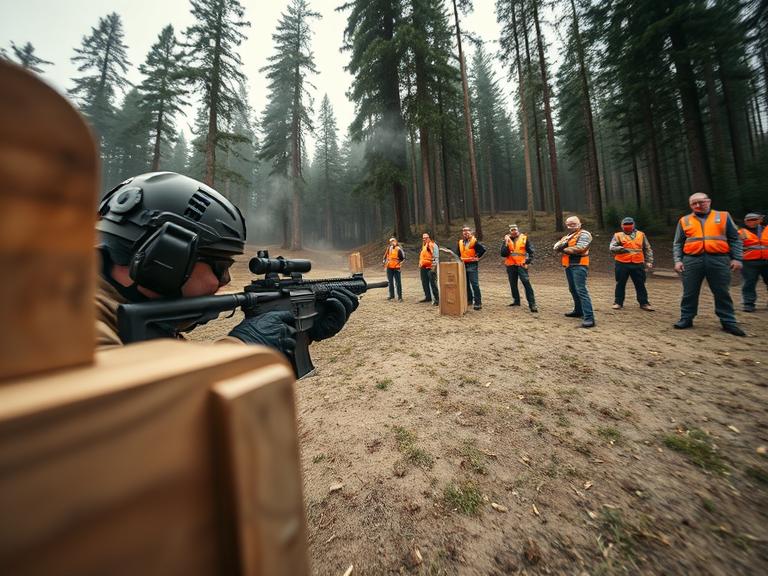
Every stage was overseen by certified Range Officers (ROs), volunteers who are the backbone of the event. Clad in distinctive orange vests, their authority was absolute. They conducted pre-stage safety checks of every competitor’s firearm and gear, issued the start commands, and closely monitored every movement. Any safety infraction, such as breaking the 180-degree safety plane (an imaginary line ensuring all shots are fired downrange) or an accidental discharge, resulted in immediate disqualification. The ROs were not just enforcers; they were also coaches and cheerleaders, especially for newer competitors showing nerves.
A Culture of Camaraderie
What was most striking last weekend was the overwhelming sense of community. While the competition was fierce, the spirit was collaborative. Competitors who had just finished their run would stick around to tape targets (replacing pasted targets for the next shooter) for their squad mates. Experienced shooters freely offered advice to novices on stage strategy or gear setup. Between stages, the parking area buzzed with conversations about ballistics, holster choices, and shared stories of great shots and costly mistakes. This culture transforms the event from a mere tournament into a gathering of a passionate tribe.
Profiles on the Firing Line
The diversity of participants was a testament to the sport’s broad appeal.
-
The Veteran: Meet David, a man in his late 60s who has been competing for over three decades. His movements were economical, not fast. He didn’t sprint between shooting positions; he walked with purpose, his focus unwavering. His accuracy was phenomenal. While younger competitors might blaze through a stage, David’s “A-zone” (center-mass) hits were consistently perfect, a masterclass in precision over pure speed.
-
The Rising Junior: Sixteen-year-old Anya was competing in her second major event. Handling her PCC with practiced ease, she displayed a level of firearm safety and handling that would put many adults to shame. Her father, also a competitor, watched from the sidelines with a proud smile. Anya represents the future of the sport—a new generation learning responsibility and focus.
-
The First-Timer: Mark, a recreational shooter for years, decided to finally take the plunge. His nerves were visible during his first stage, his hands shaking slightly as he loaded his magazine. But after the “Standby… BEEP!” of the timer, his training took over. He finished the stage safely, if not near the top of the leaderboard, and was met with a round of supportive applause from his squad. He had conquered the initial hurdle, and his grin was infectious.
The Final Tally: More Than Just Scores
As the sun began to dip behind the mountains on Sunday, the final scores were tallied. Winners in each division were awarded plaques and prizes, but the real victory for most was personal. For some, it was about achieving a personal best time on a complex stage. For others, it was about hitting a difficult target that had eluded them in practice. For everyone, it was about a weekend spent outdoors, testing their limits, and strengthening bonds with like-minded individuals.
The Last Weekend WW Shooting Competition Washington was a powerful demonstration of a sport often misunderstood by the public. It was a meticulously organized, safe, and deeply engaging event where the primary focus was on skill, discipline, and mutual respect. The echoes of gunfire have faded from the valley, but the lessons in concentration, the shared laughs, and the spirit of friendly competition will resonate with the participants until they meet on the firing line once again.
Informational FAQs
Q1: Is this type of shooting competition open to the public?
A: While spectators are sometimes allowed, participation is generally restricted to individuals who are pre-registered members of the hosting organization (like a gun club) or a national body like USPSA. All competitors must demonstrate safe firearm handling and often need to complete a safety orientation.
Q2: What are the basic safety rules enforced at such an event?
A: The fundamental rules are: 1) Always treat every firearm as if it is loaded. 2) Never let the muzzle cover anything you are not willing to destroy (the 180-degree rule). 3) Keep your finger off the trigger until your sights are on the target and you are ready to shoot. 4) Be sure of your target and what is behind it.
Q3: Do I need expensive, specialized gear to start competing?
A: Absolutely not. Many competitors start with a reliable, safe handgun, a sturdy holster, a few magazines, and a magazine pouch. The community strongly encourages newcomers to use what they have to learn the sport before investing in high-end equipment.
Q4: How can I find a shooting competition near me?
A: The best resources are the websites of national organizations like the United States Practical Shooting Association (USPSA), International Defensive Pistol Association (IDPA), or PractiScore, a popular platform used to register and manage matches. Local gun ranges and clubs are also excellent sources of information.
Q5: Is the sport only for experts and former military personnel?
A: Not at all. The sport is for everyone. Participants come from all walks of life—teachers, engineers, students, healthcare workers. The divisions and classifications are designed so that you compete against people of similar skill levels, making it accessible and rewarding for beginners.