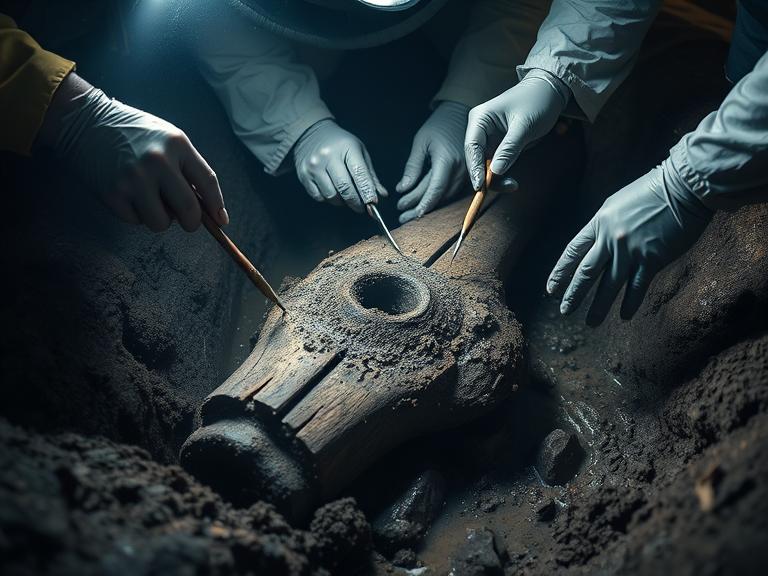
In the annals of archaeology and historical preservation, few discoveries offer as visceral a connection to our past as those found where history has been lost to the earth. While we often envision the unearthing of grand temples or royal tombs, it is frequently the smaller, more mundane objects that provide the richest insights into daily life. Among these, the process of axle excavation stands out as a specialized and fascinating discipline, revealing stories of trade, technology, and travel from bygone eras. This article delves into the meticulous world of excavating axles, the silent workhorses of ancient transportation.
What is an Axle, and Why Excavate One?
At its core, an axle is a central shaft for a rotating wheel or gear. In archaeological terms, we are typically referring to the axles of carts, wagons, chariots, and other wheeled vehicles. Unlike a precious metal artifact or a finely sculpted statue, an axle is a functional component, often made of wood or iron. Its value to the archaeologist is not inherent in its material, but in the information it encodes.
An excavated axle is a primary source. It tells us about:
-
Materials Technology: What type of wood was used (oak for strength, ash for flexibility)? Was it reinforced with iron bands? The materials speak volumes about the technological capabilities and resource availability of the culture that produced it.
-
Manufacturing Techniques: Are there tool marks from adzes, saws, or lathes? Is there evidence of joinery, such as mortise and tenon joints? This reveals the woodworking and metalworking skills of the time.
-
Vehicle Design and Function: The size, thickness, and design of the axle indicate the type and weight capacity of the vehicle it supported—a light chariot for speed versus a heavy wagon for hauling goods.
-
Trade and Transportation Networks: Finding a vehicle axle in a specific location, especially if the wood is non-native, can provide evidence of trade routes and the movement of people and goods.
The Delicate Process of Axle Excavation
The term axle excavation implies a far more delicate operation than simply digging up a piece of wood or metal. These objects have often lain buried for centuries, if not millennia, and their structural integrity is severely compromised. The process is a careful dance between archaeology and conservation.
1. Site Identification and Context
The process begins long before a trowel touches the soil. An axle is rarely found in isolation. It is typically discovered within the context of a larger find:
-
Bog Sites: Waterlogged environments like peat bogs are ideal for preserving organic materials like wood. The anaerobic (oxygen-free) conditions prevent the decay caused by bacteria and fungi. Many of the best-preserved axles come from such environments.
-
Shipwrecks: Wagons and carts were often carried on ships. A shipwreck can preserve these vehicles in a sealed, often anaerobic, context.
-
Burial Mounds or Tombs: High-status individuals, like chieftains or warriors, were sometimes buried with their chariots or carts, complete with their axles.
-
Ancient Roadways or Ruts: In areas like Pompeii or on old Roman roads, the wear and tear on the road itself can sometimes lead to the discovery of broken or discarded axle parts.
Understanding the context is paramount. The soil composition, the presence of other artifacts (like wheels, harness pieces, or animal bones), and the precise geographical location are all meticulously documented before excavation begins.
2. The Excavation Itself
Once an axle is identified, the real challenge begins. The excavator cannot simply pull it out of the ground.
-
Revealing the Object: Using small tools like trowels, brushes, and even dental picks, archaeologists slowly and carefully remove the surrounding soil. The goal is to expose the entire object without applying any pressure or stress to it.
-
In-Situ Documentation: As the axle is revealed, it is photographed and drawn in situ (in its original position). Measurements are taken relative to a site grid. This step is crucial because the act of removal will alter its context forever.
-
Assessing Fragility: The conservator assesses the condition of the wood. Is it spongy? Is it holding its shape? This assessment dictates the next critical step: stabilization.
3. Stabilization and Lifting
This is the most critical phase of the axle excavation. Waterlogged wood is particularly fragile; if allowed to dry out uncontrolled, it will shrink, warp, and crack irreparably.
-
In-Situ Stabilization: To prevent collapse during lifting, the axle may need to be reinforced. This often involves applying a temporary consolidant or carefully supporting it with bandages and a rigid cradle.
-
The “Block Lift” Method: For extremely fragile specimens, archaeologists may use the block lift technique. They excavate around the object, leaving it on a pedestal of soil. This entire block of soil containing the artifact is then encased in a rigid support (often plaster and bandages or a wooden crate) and lifted out as a single unit. This allows for the delicate excavation to continue in the controlled environment of a laboratory.
From the Field to the Laboratory: Post-Excavation Analysis
The axle excavation is only half the battle. The laboratory is where the true secrets are unlocked.
-
Conservation: The primary goal is to replace the water in the wood cells with a stabilizing agent, such as polyethylene glycol (PEG). The artifact is slowly immersed in a PEG bath over many months or even years. After treatment, it can be freeze-dried to remove the water without causing collapse.
-
Dendrochronology: This is the science of tree-ring dating. By analyzing the pattern of growth rings in the wooden axle, scientists can determine the exact year the tree was cut down, providing a precise date for the vehicle’s construction.
-
Microscopic and Chemical Analysis: Studying wear patterns, tool marks, and residue analysis can reveal how the vehicle was used. Was it carrying grain? Was it involved in a battle? Chemical analysis of metal components can trace the origin of the ores.
Case Study: The Axle that Rewrote a Timeline
Imagine an axle excavation in a peat bog in Northern Europe. The axle, made of oak, is found associated with a simple cart. Through dendrochronology, it is dated to 1200 BCE. This single discovery could push back the accepted date for wheeled transport in that region by several centuries, forcing historians to reconsider the sophistication of trade and technology in the European Bronze Age. This is the transformative power of a seemingly simple object.
Informational FAQs
Q1: What is the biggest challenge in axle excavation?
A: The biggest challenge is the fragile nature of the material, especially waterlogged wood. The primary risk is irreversible damage during extraction or from uncontrolled drying after excavation. The conservation process is long, complex, and expensive.
Q2: Are metal axles easier to excavate than wooden ones?
A: In some ways, yes, as iron and bronze are more robust during lifting. However, they are highly susceptible to corrosion. When excavated, corroded metal can be brittle and require extensive conservation to stabilize it and reveal its original shape.
Q3: Can you give an example of a famous axle excavation?
A: The Dover Bronze Age Boat, discovered in England, is one of the oldest known seagoing vessels. While a boat itself, its discovery involved similar principles. More directly, many well-preserved chariots and axles have been found in waterlogged conditions in Celtic bog sites across Ireland and Denmark, and in the tombs of Chinese emperors and Scythian chieftains.
Q4: What happens to an axle after it is excavated and conserved?
A: After conservation and study, the axle is typically housed in a museum’s collection. It may be put on display for the public or kept in climate-controlled storage for future research, as analytical techniques are constantly improving.
Q5: Why is context so important in an excavation?
A: An artifact without context is just an object. Context provides its story. Knowing that an axle was found in a burial tomb tells a different story than one found at the bottom of a well or on an ancient battlefield. The soil layers, associated artifacts, and precise location are the data points that allow archaeologists to reconstruct the past accurately.