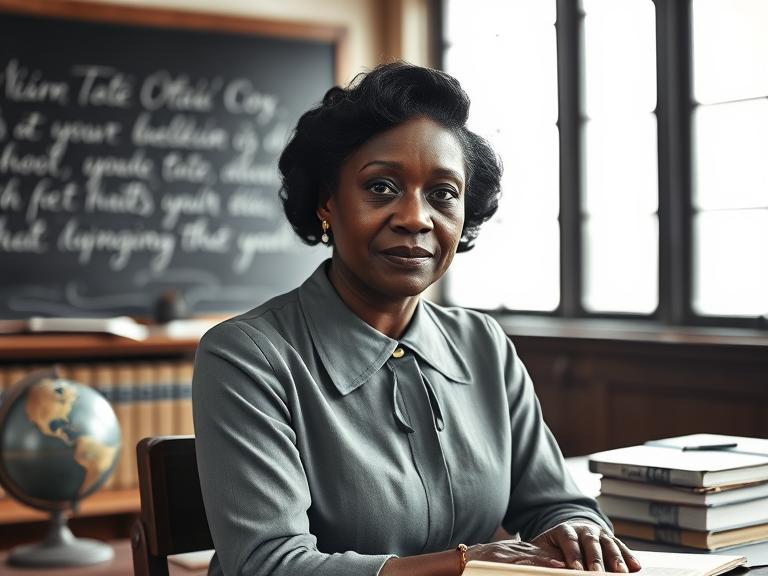
In the grand narrative of American history, certain names are etched in bold, celebrated for their loud and transformative impact. Yet, the foundation upon which progress is built is often held steady by individuals whose contributions are made not on a national stage, but in the quiet corners of their communities. Otelia Cox is one such figure—a name that may not resonate with the broad familiarity of a civil rights titan, but whose life story is a powerful testament to resilience, dedication, and the profound impact of an educator. Her journey from a child of the Reconstruction South to a pioneering school principal in the segregated Midwest is a crucial chapter in the story of Black education and community building in America.
Early Life: Forging Resilience in the Crucible of the South
Otelia Cox was born Otelia Carrie Carmichael on August 15, 1874, in Greensboro, North Carolina. Her birth came at a pivotal and precarious moment in American history. The Civil War had ended just nine years prior, and the Reconstruction era was in full, fragile swing. This was a period of immense hope and profound struggle for newly freed African Americans, a time when the promise of citizenship and rights was fiercely contested by the violent backlash of the defeated Confederacy.
Growing up in this environment, Otelia witnessed firsthand the dual forces of aspiration and oppression. Her parents, likely former slaves, would have understood that education was the key to a future of true freedom for their daughter. It was this understanding that fueled Otelia’s own academic pursuits. She attended Bennett College, then a historically Black institution in its early years as a coeducational school, which was dedicated to providing a high-quality education to Black students. Her time at Bennett would have been rigorous, not just academically, but morally and spiritually, instilling in her a sense of purpose and the responsibility to lift as she climbed.
This formative period equipped her with more than just knowledge; it forged in her an unyielding spirit. She learned that in a world designed to limit her potential, perseverance was not just a virtue but a necessity. This resilience would become the defining characteristic of her life’s work.
A Journey North: The Move to Fort Wayne, Indiana
In a move that mirrored the Great Migration—the mass exodus of African Americans from the rural South to the urban North—Otelia, alongside her husband John W. Cox, relocated to Fort Wayne, Indiana, around the turn of the 20th century. Fort Wayne presented a different landscape from Greensboro. While the North was not free from racism and segregation, it offered opportunities for economic advancement and community development that were often violently suppressed in the South.
The Coxes quickly became embedded in the fabric of Fort Wayne’s growing Black community. John found work as a laborer, and Otelia, armed with her education and conviction, turned her attention to the most critical need of her community: the education of its children.
The Heart of the Matter: Leading South Harrison School
Otelia Cox’s legacy is inextricably linked to the South Harrison School. In the era of de facto and de jure segregation, schools for Black children were often chronically underfunded, housed in inadequate buildings, and staffed by overworked teachers. The South Harrison School was the primary institution for Fort Wayne’s Black youth, and in 1917, Otelia Cox was appointed its principal.
Her leadership was transformative. She was not merely an administrator; she was the heart of the school. In a system that expected little from Black children, Otelia Cox expected everything. She demanded excellence, discipline, and pride from her students. Under her guidance, the school became more than a place of learning; it was a sanctuary—a community hub where children were taught not only reading, writing, and arithmetic but also self-respect and civic duty.
Her approach was holistic. She understood that a child struggling with hunger or a lack of warm clothing could not focus on their studies. She was known to personally look after the well-being of her students, often going above and beyond to ensure they had what they needed to succeed. She fostered a culture of high expectations and unwavering support, a combination that empowered her students to see beyond the limitations that a segregated society tried to impose upon them.
For over three decades, from 1917 until her retirement in 1949, Principal Cox was a steadfast presence. She navigated the complexities of a segregated system, advocating for her students and her school with a quiet but unassailable determination. She was a leader who led by example, demonstrating through her own life that dignity and intelligence were powerful forces against prejudice.
A Lasting Impact: The Ripple Effects of a Life of Service
Otelia Cox retired in 1949, having witnessed immense change in the world and having been an agent of change in her own city. She passed away on May 29, 1965, on the cusp of the Civil Rights Act of 1964 and the Voting Rights Act of 1965—landmark legislation that would begin to dismantle the legal structures of segregation she had spent her life working within.
Her legacy, however, did not end with her retirement or her passing. The thousands of students who passed through the halls of South Harrison School carried her lessons with them. They became tradespeople, professionals, parents, and community leaders. They carried the confidence and education she had instilled in them, contributing to the strength and vitality of Fort Wayne and beyond.
The story of Otelia Cox is a powerful reminder that the fight for equality and justice is waged on many fronts. While activists marched and lawyers argued in courtrooms, educators like Otelia Cox were fighting the same battle in the classroom. She was dismantling the myth of Black intellectual inferiority one lesson, one student, one act of belief at a time. Her work ensured that when the doors of opportunity finally began to swing open more widely, her students were prepared to walk through them.
Her life stands as a monument to the power of dedicated, community-focused service. It challenges us to recognize that history is not only made by those whose names are in headlines, but also by those whose work forms the bedrock of our communities, shaping generations with quiet, consistent, and unyielding courage.
Informational FAQs About Otelia Cox
1. Who was Otelia Cox?
Otelia Cox (1874-1965) was a pioneering African American educator who served as the long-time principal of the South Harrison School, the primary school for Black children in Fort Wayne, Indiana, during the era of segregation.
2. Where was she from?
She was born Otelia Carrie Carmichael in Greensboro, North Carolina, in 1874. She moved to Fort Wayne, Indiana, with her husband, John W. Cox, around the early 1900s.
3. What was her educational background?
Otelia Cox attended Bennett College in Greensboro, North Carolina, which was a historically Black college dedicated to educating African American students during a time of limited opportunities.
4. What was the South Harrison School?
The South Harrison School was a segregated public school in Fort Wayne, Indiana, for African American students. It was the center of the Black community’s educational life for many years, and Otelia Cox was its principal from 1917 to 1949.
5. Why is Otelia Cox significant?
Her significance lies in her decades of dedicated leadership in Black education. In a system designed to provide inferior schooling to Black children, she created an environment of high expectations, academic rigor, and holistic care, empowering generations of students to overcome societal barriers.
6. Did she have any role in the Civil Rights Movement?
While not a national figure in the movement, her life’s work was intrinsically linked to its goals. By providing a quality education and fostering racial pride, she was engaged in the foundational work of building Black community strength and preparing future generations for the struggles and opportunities ahead. Her career exemplifies the “local” activism that was crucial to the broader movement.
7. How is she remembered today?
Otelia Cox is remembered in Fort Wayne as a foundational community leader and an educational pioneer. Her story is preserved by local historical societies and is increasingly being shared as an essential part of the city’s and the nation’s history.