I. Intro: “Assimilation” – What’s the Big Deal?
Ever felt that nagging pressure to tweak yourself, to sand down the edges, just to “fit in”? That feeling, that impulse – that’s assimilation knocking at the door. But the concept, particularly as captured by the Norwegian word “assimilasjon,” holds far more than just a superficial adjustment. It speaks to a fundamental process of elements blending, adjusting, or even transforming to achieve a semblance of similarity.
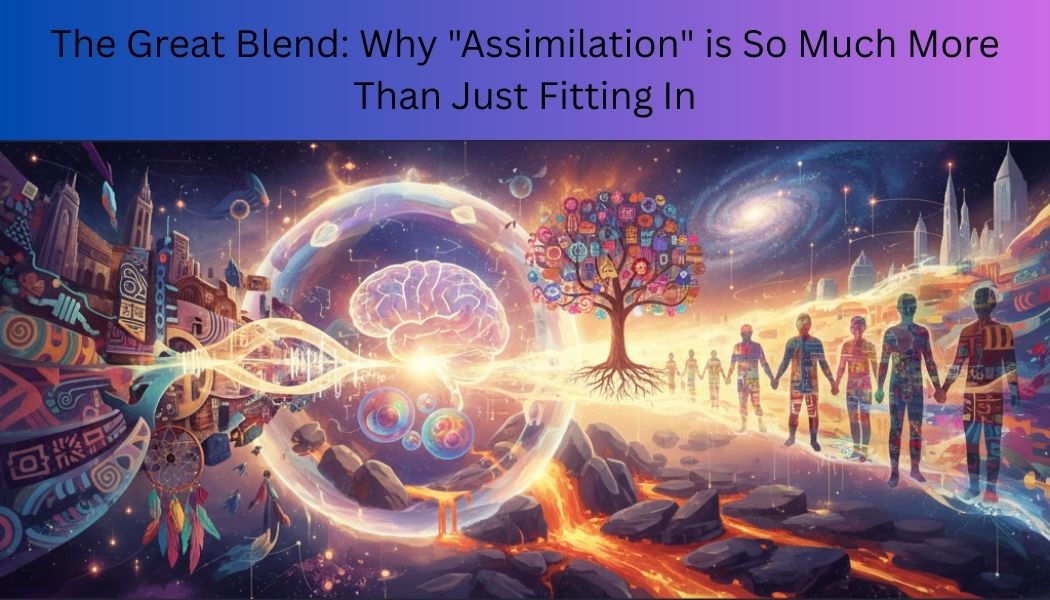
Consider the breadth of its application: linguistics, where sounds subtly shift within the architecture of your mouth; biology, where ingested matter undergoes alchemic transformations to become you; psychology, the intricate dance of your mind as it grapples with and internalizes novel experiences; even geology, where the solid gives way to the molten as rocks succumb to the fiery embrace of magma.
Yet, let’s be honest, when the term “assimilation” floats into our consciousness, our minds immediately gravitate towards people and cultures. It is here, in the messy, vibrant, and often fraught arena of human interaction, that the concept truly comes alive – and where it reveals its most complex and challenging dimensions.
II. A Trip Down Memory Lane: How “Blending In” Became a Big Idea
The very word “assimilation” whispers of its origins in the hallowed halls of Latin scholarship, its roots meaning “to make similar.” Its formal debut occurred in the 19th century within the scientific discourse of biology, initially describing how organisms absorb and integrate substances.
But it was in the early 20th century, amidst the churning tides of mass migration to the United States and Europe, that assimilation truly exploded into the public consciousness. The “Melting Pot” became the seductive metaphor, promising a harmonious blend of diverse cultures into a unified whole. However, the lived reality for many, particularly European immigrants arriving on American shores, was far more akin to “Anglo-conformity.” The price of admission often involved shedding surnames, abandoning ancestral customs, and embracing the dominant culture – a pragmatic, if often painful, strategy for economic and social survival.
And then there is the specter of forced assimilation, a dark chapter etched in human history. The experiences of Native Americans in the US and Canada, herded into boarding schools with the explicit aim to “kill the Indian in him, and save the man,” stand as a chilling testament to this brutal practice. Children were forcibly ripped from their families, their languages silenced, their cultural identities systematically erased – a trauma that echoes across generations. Similarly, the “Stolen Generations” of Aboriginal Australians endured the agonizing removal of children, a calculated assault on their very being. Let us not forget Norway’s own “Norwegianization” policies, which sought to obliterate the languages and cultures of the Sámi and Kven people, compelling them to adopt a singular “Norwegian” identity.
Even in those early days, voices rose in protest, lamenting the immeasurable cultural loss and the profound human cost exacted by these policies.
III. Assimilation Today: It’s Not So Simple Anymore
The quaint notion of a simple, linear trajectory of assimilation – a steady march towards cultural homogeneity – has been decisively challenged. Contemporary sociologists now approach the subject with a far more nuanced perspective.
The theory of segmented assimilation suggests that immigrants navigate a complex landscape with multiple pathways. Some achieve upward mobility, seamlessly integrating into the middle class, embodying the classic success story. Others, tragically, experience downward assimilation, finding themselves trapped within disadvantaged communities. Still others forge a path of “selective acculturation,” achieving economic success while steadfastly preserving their cultural heritage.
Consider the “integration paradox,” a phenomenon where individuals, despite diligently pursuing integration and achieving upward mobility, find themselves facing heightened discrimination. Many now embrace “dual identities,” skillfully weaving together their ancestral heritage with the demands of the dominant culture.
Despite the debates and the complexities, empirical evidence suggests that immigrants continue to assimilate, often rapidly, in crucial domains such as language acquisition, homeownership, and educational attainment. However, the process is no longer conceived as a uniform, all-encompassing erasure of identity.
The very concept of assimilation has become a political battleground. For some, often those on the conservative end of the spectrum, it remains a prerequisite for national unity, a binding force that holds society together. For others, particularly those with progressive leanings, it represents an anti-immigrant expectation, a culturally insensitive demand for conformity.
IV. The Elephant in the Room: Why Assimilation is So Controversial
At the heart of the controversy lies the profound pain of loss. Forced assimilation entails the relinquishing of language, traditions, history – the very essence of one’s being. This loss can trigger deep cultural bereavement, profound identity crises, and intergenerational trauma that reverberates through families and communities.
The debate often boils down to a stark dichotomy: “Assimilation is racist!” versus “It’s necessary for unity!” This encapsulates the fundamental tension at play. Critics rightly argue that traditional assimilation models are inherently ethnocentric, demanding that minorities conform to a dominant (often white, Eurocentric) standard, thereby masking underlying racism and power imbalances. Conversely, proponents maintain that assimilation is vital for fostering social cohesion and promoting economic opportunity.
Remember the “Brokaw Blunder,” when a prominent journalist casually suggested that “Hispanics should work harder at assimilation”? The ensuing uproar underscored the deeply sensitive and often misunderstood nature of this topic, exposing the ever-present specter of xenophobia and unconscious bias.
The “Melting Pot” versus “Salad Bowl” metaphor captures the essence of the debate. Do we aspire to a homogeneous stew where individual flavors are indistinguishable, or do we embrace a vibrant salad where each ingredient retains its unique character, contributing to the richness of the whole? This metaphorical clash reflects fundamentally different visions of society.
V. Looking Ahead: What’s Next for the “Blending” Concept?
The era of overt, coercive assimilation policies is, hopefully, drawing to a close. A growing international consensus recognizes the cultural genocide and enduring trauma caused by such practices.
The future points towards integration and multiculturalism, policies that encourage participation in society while safeguarding cultural identity. This includes language support programs, robust anti-discrimination laws, and the recognition of diversity as a national asset.
For nations grappling with a legacy of forced assimilation, such as Norway with the Sámi, Canada, and Australia, ongoing truth commissions, formal apologies, and sustained efforts toward cultural revitalization and reparations are paramount.
Even in the absence of explicit policies, the subtler pressures of “soft assimilation” – societal norms, media portrayals, and economic incentives – will likely continue to exert their influence, nudging individuals towards conformity.
Academic researchers are delving deeper, particularly into the experiences of the “third generation,” employing cutting-edge technologies like machine learning to dissect the complex interplay of race, religion, and socioeconomic factors in shaping integration outcomes.
Ultimately, the tension between fostering a shared national identity and celebrating diverse cultural backgrounds will continue to shape policies worldwide. The challenge lies in striking a delicate balance, ensuring that “becoming similar” does not necessitate “erasing who you are.” It is a complex, ongoing dance, one that demands empathy, understanding, and a unwavering commitment to justice.