Names are more than just identifiers; they are vessels of history, culture, and profound meaning. They carry the whispers of ancestors and the hopes of parents across generations and geographies. Few names exemplify this beautiful complexity as perfectly as the pair Maryum and Maria. While they may sound similar to the modern ear, their journeys through language, religion, and culture reveal a fascinating tapestry of shared origins and distinct identities. This article delves into the etymological, historical, and cultural narratives of these two resonant names.
The Shared Root: A Journey Back to Antiquity
To understand Maryum and Maria, one must first travel back to the ancient world. Both names share a common ancestor, making them linguistic cousins.
-
The Original Source: The ultimate root is believed to be the Hebrew name Miryam (מִרְיָם). In the Old Testament, Miryam was the sister of Moses and Aaron, a prophetess and a leader in her own right. The exact meaning of Miryam is debated among scholars, with proposed interpretations including “beloved,” “rebellion,” “wished-for child,” or even “drop of the sea” (from the Egyptian root mry). This multiplicity of meanings only adds to the name’s rich character.
-
The Greek and Latin Bridge: As Jewish and early Christian texts spread throughout the Hellenistic world and the Roman Empire, the name needed to be adapted. The Hebrew Miryam was Hellenized into Mariam (Μαριάμ) and later into the more common Latin form, Maria. This Latin version became the standard throughout the vast Roman Empire, paving the way for its adoption across Europe.
It is from this pivotal point—the Latin “Maria”—that the two paths of our names, Maryum and Maria, begin to diverge.
The Path of Maria: A Name Conquers Europe
The name Maria, carried by the central figure of Mary, the mother of Jesus, became one of the most powerful and enduring names in Christendom. Its spread across Europe is a story of faith, culture, and linguistic evolution.
-
The Christian Catalyst: The veneration of the Virgin Mary propelled the name’s popularity to unprecedented heights. For centuries, it was considered a sacred name, often used in religious contexts before becoming a common given name for girls.
-
Linguistic Diversification: As Latin evolved into the Romance languages and influenced others, Maria took on beautiful local forms:
-
Spanish/Italian/Portuguese: María, Maria
-
French: Marie
-
English: Mary
-
German: Marie
-
Russian: Mariya (Мария)
-
The name Maria (and its variants) became so ubiquitous that it often functioned as a middle name for boys, particularly in Catholic cultures (e.g., José María, Jean-Marie), signifying a blessing or dedication. Its journey represents the globalization of a religious and cultural ideal through a single, powerful name.
The Path of Maryum: An Arabic and Islamic Identity
While Maria traveled west and north, the other branch of the name evolved in a different direction, deeply influenced by the rise of Islam and the Arabic language.
-
The Arabic Linguistic Shift: The Arabic language has specific phonetic rules, and the name Miryam/Maria was adapted to fit its sound system. The final “a” sound was often nasalized or dropped, leading to the classical Arabic form Maryam (مريم).
-
The Quranic Significance: In Islam, Maryam holds a position of the highest esteem. An entire chapter (Surah) in the Quran is named after her—Surah Maryam—which is a profound honor. She is revered as a pure, righteous, and chosen woman, the mother of the Prophet Isa (Jesus). The Quranic narrative emphasizes her piety and her miraculous conception, making her a central figure of faith and an exemplary model for believers. The name Maryam is thus deeply cherished and widely used throughout the Muslim world.
-
The South Asian Adaptation: Maryum: As Islam spread to the Indian subcontinent, the name Maryam was lovingly adapted into local languages like Urdu, Hindi, and Bengali. In these linguistic contexts, the name often took on the slightly softer and more melodious form of Maryum (مریم). This is not a different name, but rather a phonetic and cultural transliteration of Maryam, reflecting the nuances of South Asian pronunciation. It carries the same religious reverence and honor but is distinctly rooted in the cultural milieu of regions like Pakistan, India, and Bangladesh.
Cultural Parallels and Distinctions: Two Sides of the Same Coin
Despite their shared origin, Maryum and Maria have developed unique cultural footprints.
Maria in the West:
-
Usage: Primarily a first name for girls.
-
Connotations: Classic, timeless, graceful, and religious. It can be both formal and approachable.
-
Cultural Presence: The name is found everywhere from royalty (e.g., Maria Theresa of Austria) to literature and music (e.g., “West Side Story’s” Maria).
Maryum/Maryam in the Muslim World:
-
Usage: An extremely popular first name for girls.
-
Connotations: Piety, strength, virtue, and high religious status. It evokes a deep sense of spiritual respect.
-
Cultural Presence: It is a name borne by millions of women, symbolizing a connection to Islamic history and values. It is a name of both tradition and modern identity.
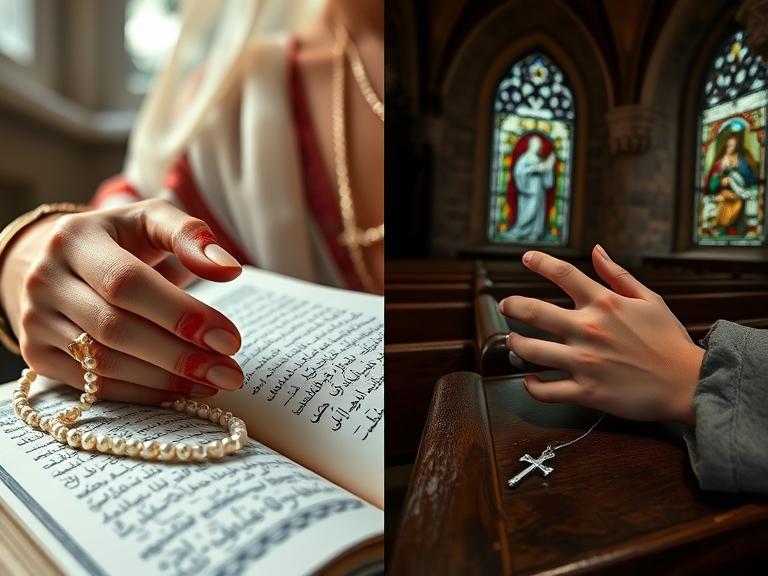
The parallel is striking: both names are dominant in their respective cultural spheres because of the reverence for a single, revered historical figure—Mary, the mother of Jesus. However, the theological and cultural lens through which this figure is viewed has shaped the specific nuances of each name.
The Modern Global Context
In today’s interconnected world, the lines between Maryum and Maria are becoming more fluid. In multicultural societies, one can find:
-
A woman named Maria who is a Muslim, reflecting the name’s universal appeal beyond its Christian stronghold.
-
A woman named Maryum living in a Western country, her name representing her family’s cultural and religious heritage.
-
The spelling Maryam is increasingly used as a common ground, recognized and pronounced easily in both English and Arabic contexts.
This blending demonstrates that while the names have distinct historical paths, they are converging once again in the global village, reminding us of our shared human stories.
Informational FAQs
1. Are Maryum and Maria the same name?
Yes, they are linguistic variants of the same original name. Maryum is a common transliteration of the Arabic Maryam, used primarily in South Asian Muslim contexts, while Maria is the Latin-derived form used widely in Western and Christian cultures.
2. What is the correct meaning of the name?
The original Hebrew name, Miryam, has several debated meanings, including “beloved,” “rebellion,” and “wished-for child.” The meanings “star of the sea” or “drop of the sea” are later, popular interpretations that emerged in Christian traditions.
3. Why is the name so important in religion?
The name is central to both Christianity and Islam due to the reverence for Mary, the mother of Jesus. In Christianity, she is the Theotokos (God-bearer). In Islam, she is known as Maryam, a chaste and righteous woman, and the only woman mentioned by name in the Quran.
4. Is it appropriate for a non-Muslim to name their child Maryum/Maryam?
Yes, absolutely. The name predates both major religions and holds significance in a Judeo-Christian-Islamic context. It is a beautiful name with a deep history that can be appreciated by anyone, regardless of faith.
5. How is Maryum typically pronounced?
The common pronunciation in Urdu and related languages is “Mar-yoom,” with the stress on the first syllable and a soft “y” sound.