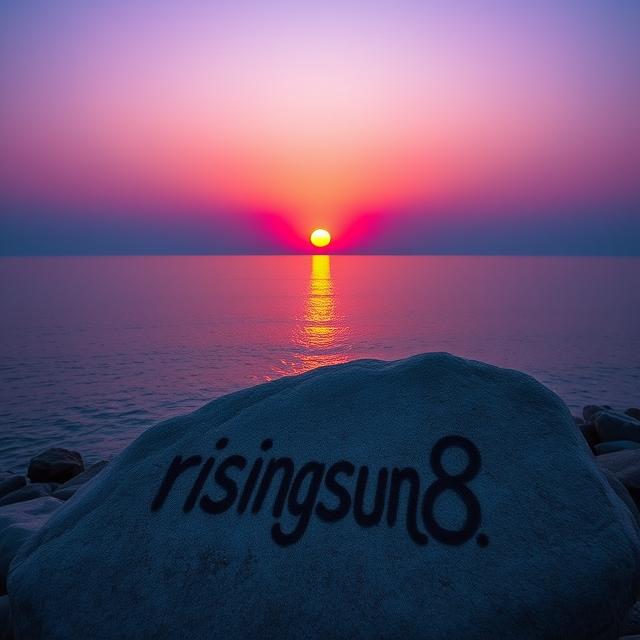
The image is universal, timeless, and profoundly powerful: the Rising Sun. It is a daily celestial event that has, since the dawn of humanity, signified hope, renewal, and the unwavering promise of a new beginning. Across every continent and culture, the sun’s ascent above the horizon has been a source of inspiration, a subject of worship, and a central metaphor in our art, literature, and philosophy. This article explores the multifaceted symbolism of the rising sun, tracing its significance from ancient myths to its modern interpretations, and considers the unique digital identity of a concept like “RisingSun8.”
A New Dawn in Human Consciousness
For our earliest ancestors, the sun was not merely a star but the primary life-giver. Its daily disappearance was a cause for anxiety, and its return each morning was a moment of collective relief and celebration. This fundamental reliance is etched into the prehistoric record. Monuments like Stonehenge in England and the Pyramid of the Sun at Teotihuacán in Mexico are testaments to the immense cultural importance of solar cycles, engineered with astonishing precision to align with the solstices and equinoxes.
In mythology, the rising sun was often personified as a deity journeying across the sky. The ancient Egyptians revered Ra, the sun god, who each night would battle the serpent of chaos, Apep, and emerge victorious at dawn in his solar barque. In Greek mythology, Helios drove a chariot of fire across the sky. The Japanese Shinto religion venerates Amaterasu, the Sun Goddess, whose emergence from a cave after a self-imposed exile brought light back to the world—a story directly emblematic of the sunrise dispelling darkness.
This archetype of victory—light over darkness, knowledge over ignorance, good over evil—is the core of the rising sun’s enduring power. It is a symbol that requires no explanation; it is felt intuitively.
The Rising Sun in Vexillology and National Identity
The symbol has also been adopted for national and regional identity, most prominently in the flag of Japan, known as the Nisshōki (flag of the sun) or more colloquially, the Hinomaru (circle of the sun). The simple, bold red disc on a white field is one of the world’s most recognizable flags, representing the sun as described in Japanese mythology. It evokes a sense of origin, purity, and brilliance.
It is crucial to approach this symbol with an understanding of its historical complexity. For many across East and Southeast Asia, the same symbol, particularly when depicted with red rays extending outward (the former flag of the Imperial Japanese Army and Navy), carries painful connotations linked to 20th-century militarism and expansion. This duality serves as a powerful reminder that symbols are not static; their meaning is shaped by history and human action. Today, the “rising sun” flag with rays remains in use by the Japan Maritime Self-Defense Force, a point of ongoing diplomatic and cultural discussion.
Beyond Japan, the motif appears in other contexts. The state flag of Arizona, USA, features a copper-colored star representing the state’s mining industry, with rays of light extending outward, mimicking a setting (or rising) sun. This illustrates the symbol’s adaptability, representing not just a nation but also local pride and natural beauty.
“RisingSun8” – A Modern Digital Interpretation
In the digital age, ancient symbols find new life as usernames, brand identities, and online communities. A handle like “RisingSun8” is a fascinating example of this evolution. What could it represent?
-
Optimism and a Fresh Start: The individual behind the name likely identifies with the core meaning of renewal and positivity. It suggests an optimistic outlook, someone who believes in always moving forward and starting anew.
-
A Connection to Heritage or Appreciation for Culture: For some, it might be a nod to Japanese heritage or a deep appreciation for East Asian art and philosophy. The addition of the number “8” is particularly interesting. In many East Asian cultures, including China and Japan, the number 8 is considered extremely lucky, symbolizing prosperity, success, and good fortune. Its shape is also seen as stable and balanced. Therefore, “RisingSun8” could be interpreted as “The Auspicious Rising Sun” or “The Prosperous New Beginning,” combining two powerful positive symbols.
-
A Gaming or Creative Persona: In online gaming and virtual worlds, a name is a avatar’s first identity. “RisingSun8” conveys strength, energy, and a dominant presence—qualities many gamers wish to project. It’s memorable, visually evocative, and carries a positive connotation.
This digital adoption shows how we continue to mine our oldest symbols for personal meaning, weaving them into the fabric of our modern digital lives.
The Astronomical Marvel Behind the Symbol
Beyond culture and symbol, the rising sun is a breathtaking astronomical phenomenon. The specific quality of light at dawn—softer, redder, and diffused—is caused by the Rayleigh scattering effect. When the sun is near the horizon, its light must pass through a greater thickness of Earth’s atmosphere, which scatters the shorter blue and violet wavelengths, allowing the longer red and orange wavelengths to dominate. This scientific explanation does nothing to diminish its beauty; if anything, understanding the physics adds a layer of awe to the experience.
This “golden hour” is cherished by photographers, painters, and poets alike for its unique emotional quality. It represents a fleeting, perfect moment of transition—a daily reminder of the world’s constant, graceful motion.
Conclusion
From the first humans who gathered to watch the sky lighten to the modern user logging in as “RisingSun8,” the ascending sun remains one of our most potent symbols. It is a testament to hope, a marker of time, a national emblem, a subject of scientific inquiry, and a personal mantra. Its meaning is layered, shaped by history, culture, and individual experience. It reminds us that no matter how dark the night, a new day always offers the chance to begin again. In a world of constant change, the reliability of the rising sun is a profound comfort, a celestial promise kept each and every morning.
Informational FAQs
Q1: Is the rising sun symbol exclusive to Japan?
A: No, the concept of the rising sun as a symbol of new beginnings is universal and appears in the myths, art, and symbolism of countless cultures worldwide, from ancient Egypt to Native American tribes. Japan has adopted it most prominently for its national flag.
Q2: What does the number ‘8’ signify in the context of “RisingSun8”?
A: In many East Asian cultures, the number 8 is considered highly auspicious. It symbolizes prosperity, success, and good fortune because its pronunciation in languages like Chinese and Japanese is similar to the word for “wealth” or “prosper.” Therefore, it amplifies the positive meaning of the “Rising Sun.”
Q3: Why does the sun look red or orange when it rises?
A: This is due to Rayleigh scattering. At sunrise and sunset, sunlight passes through more of Earth’s atmosphere. The atmosphere scatters the shorter blue and violet light waves, allowing the longer red and orange wavelengths to reach our eyes directly.
Q4: How is the rising sun used in modern media?
A: It is a ubiquitous cinematic and literary device. Filmmakers use a sunrise to signify the end of a crisis, a new chapter for a character, or a moment of hope. It is a visual shorthand for optimism and resolution.
Q5: Are there any annual festivals that celebrate the sunrise?
A: Yes, many cultures have celebrations tied to the sun. In Japan, many people visit the coast or mountains on New Year’s Day to witness the first sunrise of the year (Hatsuhinode), a practice believed to bring good luck for the coming year.