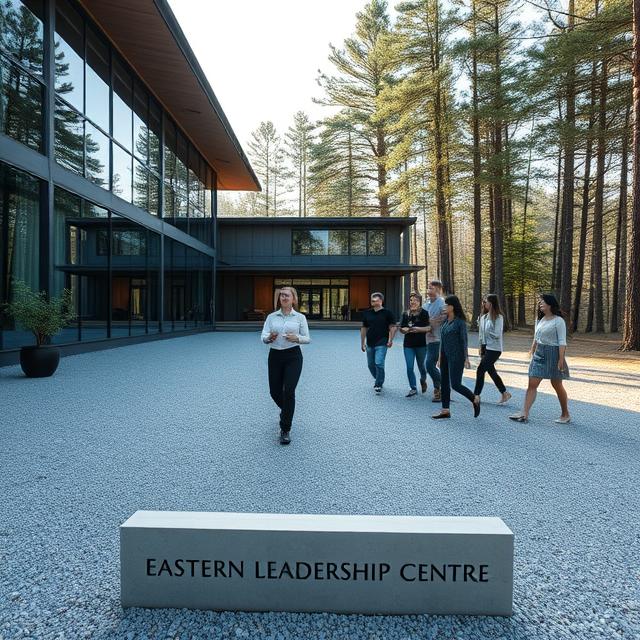
In a world characterized by rapid globalization, technological disruption, and complex socio-economic challenges, the demand for effective, adaptable, and conscious leadership has never been greater. Traditional, top-down leadership models are increasingly proving inadequate for navigating the nuanced landscapes of the 21st century. This has given rise to a growing interest in leadership paradigms that draw from diverse cultural, philosophical, and spiritual traditions. It is within this context that institutions like the Eastern Leadership Centre emerge as vital hubs for cultivating a new generation of leaders. But what exactly is such a centre, and what unique value does it offer?
The term “Eastern Leadership Centre” does not refer to a single, specific institution but rather evokes a concept—a type of organization or philosophical approach dedicated to exploring and teaching leadership principles rooted in or inspired by Eastern philosophies. This includes the rich intellectual and spiritual traditions of Asia, such as those from China, Japan, India, Korea, and the Middle East. The core mission of such a centre is to bridge the gap between the performance-driven metrics of Western business practices and the wisdom-oriented, holistic approaches found in the East.
The Philosophical Pillars of Eastern-Inspired Leadership
A theoretical Eastern Leadership Centre would likely be built upon several foundational principles that distinguish it from conventional leadership academies. These are not rigid rules but guiding philosophies that inform its entire curriculum.
-
Leading with Mindfulness and Presence: Drawing heavily from Buddhist and Taoist traditions, this principle emphasizes self-awareness as the bedrock of leadership. Before one can hope to lead others, one must first understand one’s own mind, biases, and triggers. Practices like meditation, mindful listening, and reflective journaling are not extracurricular activities but core training modules. This cultivates a leader who is calm, focused, and capable of making decisions from a place of clarity rather than reactive emotion, especially in high-pressure situations.
-
The Principle of Wu Wei (Effortless Action): A concept from Taoism, Wu Wei is often translated as “non-action” or “effortless action.” It does not advocate for passivity but rather for acting in harmonious alignment with the natural flow of events—like a skilled sailor using the wind rather than fighting against it. For a leader, this means understanding the dynamics of their organization and market so profoundly that their interventions are timely, appropriate, and seem almost effortless. It is the antithesis of micro-management and forceful control.
-
Servant Leadership and Humility: While the term “Servant Leadership” was popularized in the West by Robert K. Greenleaf, its roots are deeply embedded in Eastern thought, particularly in Confucianism and the Hindu concept of seva (selfless service). An Eastern Leadership Centre would teach that true authority is derived from a commitment to serving the needs of one’s team, organization, and community. The leader is a facilitator and enabler, not a glorified commander. This fosters immense loyalty, trust, and collective purpose.
-
Systems Thinking and Holism: Eastern philosophies often view the world as an interconnected, interdependent system. This contrasts with the more reductionist, analytical approach common in the West. Leadership, therefore, is understood as stewarding a complex ecosystem. Decisions are evaluated not just on their immediate, linear outcomes but on their ripple effects throughout the entire organization and society. This fosters sustainable, long-term thinking over short-term gains.
-
Cultivating Resilience through Adversity: Concepts like the Japanese principle of kintsugi (repairing broken pottery with gold, highlighting the breaks as part of an object’s history) or the mindset of fudoshin (immovable mind or calmness in the face of adversity) teach that challenges and failures are not setbacks to be hidden but integral parts of the growth process. An Eastern Leadership Centre would equip leaders to embrace adversity, learn from it, and emerge stronger, transforming scars into strengths.
The Structure and Offerings of an Eastern Leadership Centre
A centre dedicated to these principles would likely offer a blend of theoretical learning and immersive, experiential practice. Its programs might include:
-
Executive Retreats: Intensive, often residential, programs held in serene environments conducive to reflection and deep learning. These would combine philosophical discourse with practical workshops on communication, strategic thinking, and personal well-being.
-
Long-Term Development Programs: Multi-month journeys that include coaching, mentorship, community projects, and the application of principles within the participant’s own organization, allowing for tangible, measurable growth.
-
Public Workshops and Seminars: Open sessions on specific topics like “Mindful Decision Making,” “Leading with Compassion,” or “Building Resilient Teams,” making the wisdom accessible to a broader audience.
-
Academic Research and Publication: To cement its credibility and contribute to the global discourse on leadership, such a centre would likely engage in rigorous research, publishing papers and case studies on the efficacy of Eastern leadership principles in modern organizational contexts.
The Modern Leader and the Eastern Advantage
Why is this approach so relevant today? The modern workforce, particularly younger generations, increasingly values authenticity, purpose, and ethical conduct in their leaders. They are less impressed by authority derived from title alone and more by competence, empathy, and a clear moral compass.
Leaders trained in an Eastern-inspired model are better equipped to:
-
Navigate ambiguity and complexity without succumbing to stress.
-
Foster inclusive, collaborative, and innovative cultures where diverse voices are heard.
-
Make decisions that balance profit with planetary and social well-being.
-
Inspire loyalty and engagement through genuine care and service.
-
Maintain their own well-being and avoid the burnout that plagues so many high-level executives.
In essence, an Eastern Leadership Centre is not about rejecting Western business acumen. It is about complementing it. It provides the crucial “software”—the inner operating system of awareness, ethics, and connection—that allows the “hardware” of strategy, finance, and marketing to function at its highest and most sustainable level. It represents a holistic journey inward to cultivate the capacity to lead effectively outward, offering a timeless wisdom for our modern world.
Informational FAQs About the Eastern Leadership Centre Concept
Q1: Is the Eastern Leadership Centre a real, physical place?
A1: The term is used here conceptually. While there are many institutions, academies, and retreat centers around the world that teach Eastern-inspired leadership principles (e.g., in Bali, India, or Japan), there is no single, universally recognized “Eastern Leadership Centre.” This article describes the philosophy and potential structure of such a concept.
Q2: Do I need to be familiar with Eastern philosophies to benefit from this approach?
A2: Not at all. These centres and programs are designed to translate ancient wisdom into practical, applicable tools for modern leaders from all cultural and professional backgrounds. The teachings are universal and focused on real-world application.
Q3: Is this type of leadership training only for CEOs and senior executives?
A3: Absolutely not. While executives are a key audience, the principles of self-awareness, effective communication, resilience, and service are valuable for anyone in a position of influence, from team leads and project managers to community organizers and educators.
Q4: How does this approach deal with hard metrics like ROI and performance?
A4: Effective leadership directly impacts bottom-line results through higher employee engagement, reduced turnover, enhanced innovation, and better decision-making. An Eastern Leadership Centre would teach that inner development is not separate from business performance but is its foundation. Many programs will include modules on measuring the impact of these soft skills on hard metrics.
Q5: Is there a religious component to this training?
A5: The approach is philosophical and practical, not dogmatic or religious. It draws wisdom from cultural and spiritual traditions but presents it in a secular, evidence-based framework focused on personal and professional development. The goal is practical effectiveness, not religious conversion.