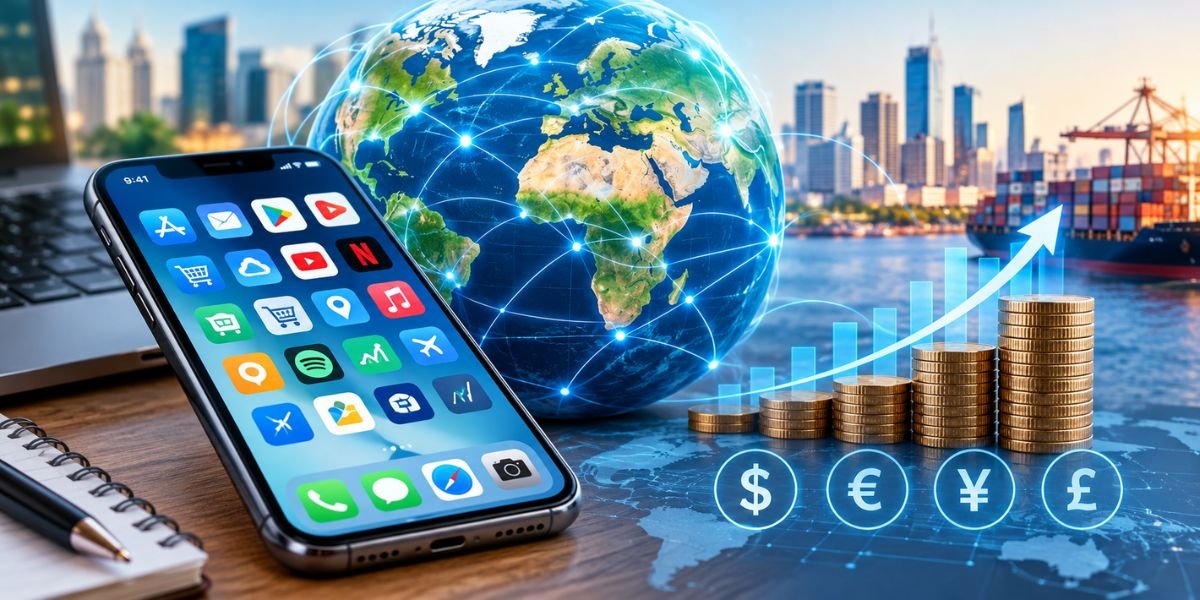
It’s easy to think of a smartphone as just a personal device — something you use to text, scroll, or stream. But zoom out, and mobile technology has quietly become one of the largest economic forces on the planet, powering trade, remote work, and financial access for billions of people who had none of that a generation ago.
The Scale Is Genuinely Enormous
According to GSMA’s Mobile Economy 2026 report, mobile technologies and services generated $7.6 trillion for the global economy in 2025, equivalent to 6.4% of global GDP. That’s not a niche sector — that’s a meaningful slice of everything the world produces in a year. And the trajectory points sharply upward: the industry’s economic impact is projected to grow to $11.3 trillion by 2030, as growth in the sector shifts away from traditional connectivity and increasingly toward high-value services layered on top of it. The Mobile Economy 2026 +2
Connectivity itself is nearly universal at this point. Mobile now reaches roughly 5.8 billion unique subscribers, about 70% of the world’s population — a scale that puts mobile phones ahead of nearly every other piece of infrastructure humans have ever built, in terms of sheer reach.
How Smartphones Actually Move the Economic Needle
The GDP figure isn’t just about phone sales or telecom revenue. It reflects several distinct channels through which mobile technology reshapes how economic activity happens:
Market access without a storefront. App marketplaces like Google Play and the Apple App Store let entrepreneurs reach global customers without ever opening a physical location, dramatically lowering the barrier to starting a business — something that mattered far less a decade ago when distribution required capital, real estate, and logistics most small players couldn’t afford.
Financial inclusion for the previously unbanked. In many developing economies, mobile-money platforms have brought formal savings and payment tools to people who never had access to a traditional bank account, expanding financial participation in ways that legacy banking infrastructure simply couldn’t reach at scale.
Productivity untethered from geography. Tools like Zoom, Slack, and Teams have made it possible for output and location to fully decouple — a worker in one country can now contribute meaningfully to a team or company based anywhere else, a shift that’s reshaped labor markets far beyond the tech sector itself.
The Pressure Points Emerging in 2026
None of this growth is happening without friction. A few structural pressures are worth watching:
Rising component costs are squeezing budget hardware. Memory chip prices — DRAM and NAND — have been climbing, partly driven by surging demand from AI data centers competing for the same manufacturing capacity. That cost pressure lands hardest on lower-cost smartphone brands that operate on thin margins to begin with, making it harder for them to compete on price the way they once did.
The market is polarizing by tier. Premium brands are consolidating their dominance at the high end, while budget-segment manufacturers increasingly get squeezed from both directions — rising input costs on one side, and less room to raise consumer prices on the other.
Emerging markets face a mixed picture. Regions like South Asia and parts of Africa continue to see youth-driven digital adoption leapfrog older infrastructure entirely — going straight to mobile-first internet access without ever building out traditional landline or desktop infrastructure. But inflation and rising hardware import costs are putting real pressure on mid-tier device demand in exactly these markets, creating tension between growing digital appetite and shrinking affordability.
Why This Matters Going Forward
What makes this shift significant isn’t just the dollar figures — it’s that mobile technology has become genuine economic infrastructure, comparable to roads or electricity grids in earlier eras. The report notes that continued growth increasingly depends less on basic connectivity and more on how effectively operators and platforms can move into higher-value services, from AI-powered tools to embedded financial products.
For businesses, that means the opportunity isn’t just in selling phones or connectivity anymore — it’s in building the software, services, and platforms that run on top of that infrastructure. For emerging economies, it means mobile access increasingly determines who gets to participate in the modern economy at all, and who gets left on the sidelines by rising hardware costs.
The bottom line: smartphones stopped being just a communication tool a long time ago. They’re now one of the primary rails the global economy runs on — and how that infrastructure evolves over the next few years, particularly around AI integration and affordability in emerging markets, will shape economic participation for a huge share of the world’s population.